Meniscus Tears… Why surgery isn’t always necessary


Type of Meniscal Tears... courtesty of AAOS.org
Transcript:
Meniscus Tears
Good morning. Let’s talk about meniscus tears. A meniscus is a cartilage disk that’s found in the knee. There are actually two of them. We have one on the inner side of the knee which we call the medial meniscus and one on the outer side of the knee which we call the lateral meniscus. These two disks function as shock absorbers or cushions to minimize the stress on another type of cartilage that we have in the knee which we call the articular cartilage. The articular cartilage is the cartilage that actually coats the ends of the bones so it’s present on the bottom of the femur, at the knee, on the top of the shinbone or the tibia and it’s present in all our other joints as well. If the two menisci are not present or they’re torn, then the articular cartilage sees an increase in stress and can trigger the onset of osteoarthtitis. That is by no means the only cause of osteoarthritis. However, it is certainly a significant contributor.
For a visual guide, here is a great video on the anatomy of the knee. This will show you where the menisci are located and why some meniscus tears can hurt as they are “sandwiched” between the end of the femur (thigh bone) and the tibia (shin bone).

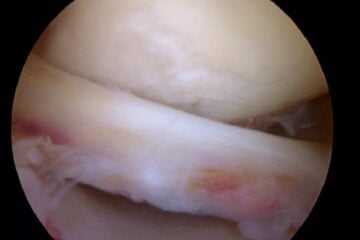
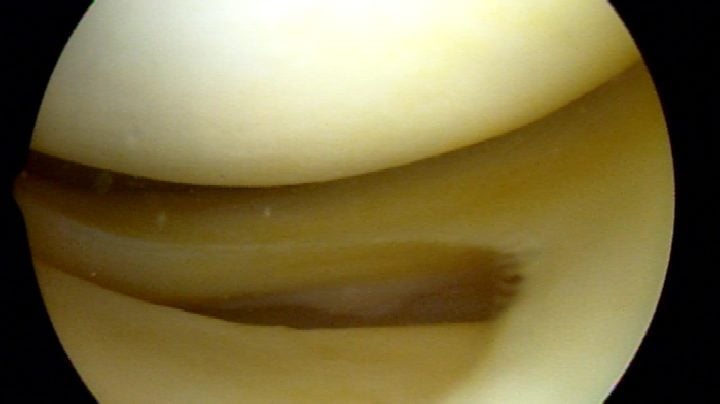
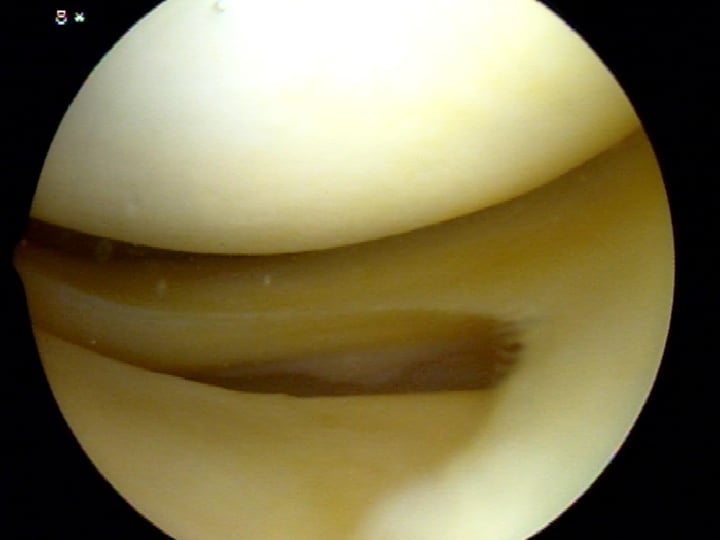
Normal appearance of a meniscus, the "C" shaped disc between the two bones.
Why do mensicus tears occur?
Now I see many patients every week who present with knee pain and many of them are suffering from meniscus tears. Why/How do we get meniscus tears? Why do these little meniscal disks tear so easily once we reach our fourth, fifth decades and beyond? Our meniscal tissue is non-regenerative. It’s similar to our brain or our heart tissues. If we have a heart attack or a stroke, we do not regenerate those areas of our heart or our brain. It simply scars in. Yet if we cut our skin, our skin heals. That tissue is regenerative, same with muscle and a lot of other tissues in our body.
The meniscal tissue has very few mechanisms for repairing itself. Therefore, every step that you’ve taken, every twist that you’ve done, every time you’ve knelt down or squatted down, you’ve put a force across that meniscus and eventually it wears out and the meniscus tears. (This is why most tears are called degenerative meniscal tears) Sometimes it tears just turning and reaching for something in your refrigerator. A lot of times people will note that they knelt down to pick up something up and when they went to stand up they felt something rip inside their knee and noted the onset of pain.
When does a meniscus tear hurt?
The typical patient with a meniscus tear doesn’t have much in the way of pain with walking straight ahead. Sometimes they do. It depends on the size of the tear but usually they’ll tolerate walking in a single direction very well. Patients with meniscal tears will complain of pain going downstairs. They’ll have pain getting up from a seated position. They’ll have pain with turning, pivoting and twisting and some patients, if the meniscus tear is large will complain that the knee is buckling or giving way or feels unstable.
I also see a number of patients in the office for a second opinion who have been told that they have a meniscus tear on an MRI which was obtained simply because they had pain one day and were immediately sent for an MRI (That’s a topic for another discussion) — and the MRI revealed a degenerative meniscus tear and now they’re being told by an Orthopedic Surgeon that they need surgery to “fix or repair that tear”– and they wonder if I agree.

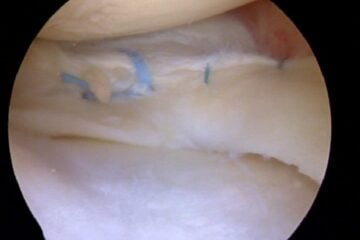
Meniscal tear with loose flap
Types of meniscus tears?
What are the different types of meniscal tears? There are degenerative meniscal tears . When you look at it, the edges are simply frayed. The tissue has been destroyed from years and years of use. Nothing you did wrong. The tissue simply wore out. Again, like my analogy with the rotator cuff, it’s like the front of a pair of blue jeans that you’ve worn for decades and the material just simply wore out.
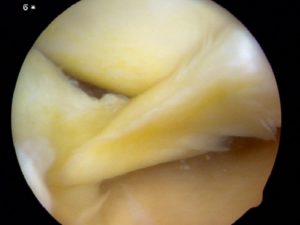
Then there are those who have suffered more acute meniscus tears and these tears can have different shapes and different patterns — and based on the shape and pattern will determine how symptomatic or how bothersome the meniscus tear will be. If a loose flap of tissue is created and that flap is moving around within the knee—that’s when you’re going to have giving way and you’re gonna have pain with many activities. You’re not going to tolerate those tears well and those patients with flap tears (or unstable tears) will usually (not always) go on to require an arthroscopy or a scope to try to either repair or remove that torn piece.
Most people with degenerative meniscal tears may have one or two exacerbations or periods during the year where their knee hurts but by and large they get around just fine and lead very active lifestyles with these degenerative tears and do not require an arthroscopy for treatment of those tears.
So the decision as to whether or not surgery is necessary is really based upon the pain you’re experiencing, the effects it’s having on your quality of life, the type of tear that you have and how long you’ve been experiencing the symptoms. ( It is (ultimately) YOUR DECISION whether or not surgery is necessary!!)
We Treat Patients, NOT MRI findings…
Most meniscus tear pain will subside within a few weeks of onset. If your pain start to improve. If the pain does not interfere with your quality of life. If your range of motion is well maintained and you can participate in your normal daily activities — then why would one consider surgery a necessity? Again, physicians need to learn to treat the patient, and not the disease.
How are mensical tears treated?
If you have knee pain, you are referred for an MRI fairly early and you’re found to have a degenerative meniscus tear — I typically advise patients to simply just wait. A lot of times your symptoms will go away and either they’ll never come back or they’ll come back once or twice a year and you’ll still be able to lead a very active lifestyle. If you sustain an injury and you have a very unstable tear, a tear we call a horizontal cleavage tear or a radial tear or a flap tear, those tears tend to remain symptomatic —and if after four, five, six weeks, you still have the same degree of discomfort and quality of life issues, then you might be a good candidate for an arthroscopy. Physical therapy can help those of you whose knees feel unstable or weak, and it can help those of you with significant swelling to gain back your motion, stability and strength. Therapy can be beneficial before surgery (pre-habilitation) , instead of surgery — or after surgery.
Do all meniscal tear require an arthroscopy?
Maybe if you’re Jeremy Lin — but for most…
What exactly is an arthroscopy? I suggest you check out my website further, where you can find some good animated videos about what exactly an arthroscopy entails. There is also a section that goes into even further detail about meniscus tears and the treatment alternatives. Basically an arthroscopy involves bringing you into the operating room, inducing a light sleep, injecting local anesthesia and then placing a fiber-optic camera into your knee through a 1/4 inch incision. We then inspect the entire joint, find the tear and determine if it will be removed or stitched back into place. Most procedures take 15-45 minutes and you are able to go home the same day. Whether or not you can return to sports soon will depend on which procedure you had — repair versus removal.
So if you have a meniscal tear, it’s not all doom and gloom. Many meniscal tears do not require surgery. Some of them do. Some meniscal tears are repairable. Some are simply removed.

This tear is displaced and caught between the two bones of the knee

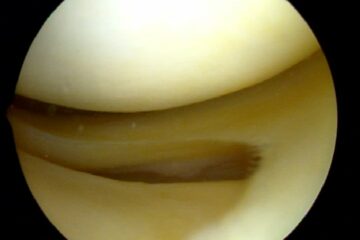
The same tear, put back into position and sutured into position
We try to repair meniscus tears whenever possible — but only certain tears are in fact repairable. One caveat: If you have a meniscal tear and you’re experiencing instability or giving way, be very careful with your activities. You don’t want to find yourself on the stairway carrying a load of objects and your knee gives way. If you have instability symptoms, make sure that you have a hand available to hold onto something at all times while you are in your recuperative phase or awaiting surgery or simply waiting to see if the symptoms are going to recover on their own.
Hope you enjoyed this post on – Meniscus Tears… Why surgery isn’t always necessary — for more information there is a more in depth section on meniscus tears here.
And by no means is this urgent surgery or emergent surgery. Take your time, rest and consider a second opinion.
Click to explore if PRP a Treatment Option for your condition?
Due to the overwhelming success of this meniscus tear post, I want to make sure that the many and varied needs that each of you have are met during your visit here. With that in mind , you may benefit in reviewing these related posts on this site:

ACL or Anterior Cruciate Ligament Tears
Meniscus Tears: A more formal discussion
Sometimes “Abnormal” MRI Findings are NOT abnormal
Treat Patients as People … Not Their MRI Findings
Thank you for visiting, I hope your time spent has been beneficial. Please feel free to share with your friends or join in the conversation at Facebook.com/Howard/Luks.MD
If you reside in Westchester or Dutchess County, NY… and are in need of Orthopedic care, feel free to contact us at 914-789-2735 to request a consultation
As always, my disclaimer applies. This is not medical advice. You should discuss these issues with your orthopedic surgeon or your family, friends and primary care doctor to determine if based upon your symptoms and quality of life you feel you would rather be treated surgically or nonsurgically. If you have any questions, feel free to hit me through my website, YouTube, Twitter, Facebook and wherever else I reside.
Source: howardluksmd.com via Howard on Pinterest
Related posts:


Good afternoon. Could I please ask your opinion. I have a torn meniscus and the MRI findings are as follows: “No evidence of fracture or dislocation. No suspicious focal bony lesion. No obvious soft tissue abnormality. Trace joint effusion. Quadriceps tendon and patellar tendon are intact. Anterior cruciate ligament and posterior cruciate ligament are intact. Medial collateral ligament and lateral collateral ligament are intact. Mild anterior extrusion of the anterior horn of the medial meniscus. Complex tear involving the posterior horn of the medial meniscus which extends into the body of the meniscus and to a lesser extent into the anterior horn. Underlying mucoid degeneration of the medial meniscus. The lateral meniscus is intact. No significant chondromalacia patella. No significant chondromalacia of the articular cartilage of the medial and lateral compartments. Impression: Complex medial meniscal tear.” My knee was hurting terribly and I scheduled surgery.
During the past week, my knee isn’t hurting very much and I am questioning whether I should have the surgery.
I would like your opinion. Thank you very much!!! Judy Douglass
In general, many patients with meniscal tears will experience relief after a period of rest, ice, activity limitation, etc. Degenerative tears tend to be less bothersome and require surgery less frequently than other tears — especially flap tears. Many, many patients with meniscal tears can be managed without surgery. This assumes they do not have instability or that the knee is stable and not giving way… and this assumes that the pain is improving and tolerable. Ultimately this becomes a quality of life decision.
Seems like you may have answered your own question. You can always call your surgeon and have another evaluation or seek a second opinion.
These are general recommendations and my disclaimer needs to apply .
Great Article Dr. Luks,
I have one additional question. If left untreated without surgery, can a meniscal tear cause further damage to the structure of the knee?
This is assuming that the knee does not lock and pain is minimal. I am a very active 20 something that is involved in contact sports similar to wrestling. I am still training and perform reasonably well. The only time my knee feels uncomfortable is when its in full flexion, heel touching my butt – my knee would pop but without pain. I am able to modify my activities/ movements that do not put me in that position too often…
Thanks,
Louis
Louis… in general, if someone is experiencing mechanical symptoms because of a tear, they could theoretically be injuring the articular cartilage on the ends of the bones. If a patient is not experiencing any mechanical symptoms (popping, catching, locking, giving way) than it is reasonable to assume that you are not causing any significant damage.
Of course my disclaimer needs to apply.
Thanks for the quick reply,
My knee does pop, but only in full flexion when my heels are touching my butt. (For example, when I sit in a kneeling position in Jiu-jitsu. I stopped sitting like that now.) In this case, do you think surgery is necessary to prevent further damage. I understand these are general recommendations, but I am curious.
It’s strange because I rarely experience any pain. Perhaps once when the actual injury occured, and once a few weeks back when my injury sort of flared up (it went away after a few days).
I fell in the snow over a year ago and immediately felt pain. I had two MRI’s. The second MRI finally showed a complex medial tear of the knee. I have some weeks where my pain is down to zero (out of 10). But the pain seems to always come back twice as bad. It starts out with discomfort at night and then pain all day. I have had therapy and the pain is aggravated if I get on an elliptical machine. My knee pops all the time and does feel like it will give out. The doctor told me that I am a candidate for arthroscopy. I am unsure because since I have last been to the doctor (almost two weeks ago) my pain is back to zero. I am only 33 but overweight. I am worried if I go with the surgery it will make things worse. I would like your opinion.
Nola… I hope that my video helped you answer some of your questions??? It is not always an easy decision… and it is a *quality of life decision* that you should make after having a nice sit down with your surgeon. Many patients who experience pain on a *routine basis* will elect to have surgery… but many will not. That’s why you need to enter into a “shared decision making” (SDM) with your surgeon and go through your issues and come to a *team* decision as to whether or not surgery may or may not be in your best interest.
nice article Dr. Howard
i have a question here , If left untreated without surgery for a while let us say two months or like , can a meniscal tear cause further damage to the structure of the knee? .
i am waiting to return back to my country to check some other orthopedics.
regards
Dr. Luks,
First off, let me thank you for having this website so that people like me can get an opinion from a doctor who does not have a “direct interest” in my knee.
I am 61, 6 feet tall and 260 lbs. I go up and down a flight of stairs at least 15 times a day. Starting around March 1, 2011, I started to have knee pain for no reason when getting out of chairs. It progressed somewhat over time to where I am now. I had an MRI done and this is the result.
FINDINGS: There is a small to moderate joint effusion. There is marked thinning of the patellar cartilage starting at the patellar region extending to medial facet. mild subchondral edema medial patellar facet associated with area maximum chondral thinning. No acute or unstable osteochondral lesion at the patella. There are subchondral cysts in the posterior tibia at the proximal tibiofibular articulation felt to be degenerative. Small subchondral cystic area – edema seen weight-bearing portion of lateral tibial plateau. Marrow signal otherwise normal. There is moderate medial and lateral join space narrowing with chondral thinning and irregularity both compartments. Irregular tear anterior horn and body of lateral meniscus. medial meniscus appears intact. with only questionable minimal free edge fraying. Cruciate and collateral ligaments appear intact. There is a 6 mm calcific density posterior joint, surrounded by joint fluid either a synovial cyst just posterior to the joint capsule or in the joint space possibly representing a loose body.
IMPRESSION: Triple compartment degenerative changes described. Joint effusoin and synovitis. Tear degeneration ante horn body of lateral meniscus. no definite medial meniscus tear. Calcific density surrounded by joint fluid, posteriorly, possibly loose body or calcific density in posterior synovial cyst.
I don’t like the idea of surgery AT ALL. I will do anything to prevent it. Is stair climbing and decending making my worse? Do I need surgery? Any advice will be greatly appreciated.
Gary
Gary… Thanks for stopping by and thanks for your comments. Please do not take this as personal medical advice… and my disclaimer needs to apply here.
The decision to have surgery for a mensicus tear is generally a “quality of life” decision. Many patients do very well and lead very active lifestyles without having their mensical tears treated surgically.
In addition, there are a number of other things to consider…. such as the realistic chance of obtaining pain relief. The success of an arthroscopy, which can NOT address or alleviate pain from severe degenerative (arthritic) changes, will depend upon whether or not other problems are present. Arthroscopy for just a meniscus tear is, in general, far more effective than arthroscopy for a mensicus tear in the presence of significant degenerative changes.
Do you need surgery? I don’t know? What do you think? What are your non-operative and operative options? What is the realistic chance you will experience relief following an arthroscopy with your MRI findings? Will you require a knee replacement in the future? These are all questions you need to explore with your treating physician.
I had my meniscus tear surgically repaired on March 7, 2011. In the the last 3 weeks it feels just like it did before the surgeon fixed it. My question is Could I have tore it again?
Julie… It’s hard for me to comment on that. Too many variables… was there arthritis found, was tear addressed well, etc, etc… This is something to talk to your surgeon about.
Thanks for stopping by.
Hello i had a soccer knee injury on december 2010.The doctor said i could have microtears in my knee.i went for physiotherapy for a month.And 3 months later now,i feel pain in my knee.I went to the hospital and the docter said i have meniscus tear.should i have surgery?(i am into competitve sports but im wondering if i could have physiotherapy all the way instead of surgery ?)
Not quite sure what a “micro-tear” is? Not a term we typically use in reference to a meniscus. Either way, if you have a meniscus tear, your decision to have surgery should be based on the effect the tear is having on your quality of life (assuming your physician believes the tear is the source of your pain). If there is little or no arthritis present, and the doctor feels you will do “well” after surgery then you can consider it. This is what I reference when I talk about the personality of an injury ( http://goo.gl/19y6k ). Not all tears behave the same in all patients. Not all patients are active or have discomfort. Therefore some might choose to have surgery and some may not. Time to have a sit down and heart to heart with your physician who can guide you utilizing Shared Decision Making principles.
Good Luck and pls not that my disclaimer needs to apply
Hello Dr. Luks,
I believe I tore my meniscus while running or playing tennis. I saw an Orthopedic Doctor and he said he is 99% sure that it is a meniscus tear and if so surgery is the way to go. I am having an MRI to confirm in 3 days. My question is, if I walk around on it prior to finding out for sure by the MRI… errands, cooking, etc… can I damage it further? I am a very active person and the thought of being a couch potato until I get this resolved is distressing. I appreciate any insight you can provide.
Thank you.
Hi doc I had atherspoic on my lateral meniscus just had trimming and removing of the torn meniscus 16 days later when I. Squat down I have man just by the outer part of kneecap below were the incicison was made and swelling there is this normal
Hello Doctor,
I have a meniscus tear and a tear in my ACL. this happend about 10 years ago and about every six months I have problems with my knee (pain etc) I can excersice without any problems, except jumping. Should I have a surgery? My doctor says I should by I am leaving a normal life and I am afraid of been worst after than now.
Please help me
thank you very much for your time.
hi doctor,
i am a 45 yr old woman who fell 3 yrs ago; my rt knee never really felt “right” after that. have had a few incidence since falling of it swelling with lots of pain involved, but they would always subside. that is until recently, approx. 5 wks ago, my knee began swelling and aching so much i had to break down and go to er. i now have problems with it that i did not originally have after the original fall (3 yrs ago), such as popping, clicking and locking with great amounts of pain involved.
i was referred to an OS, who ordered an MRI, but i just found out that the results don’t show any significant problem.
is there any way that i can be in this much pain, but have no reason for it? (btw-no arthritis showed on x-ray taken at doc’s office either).
i am totally baffled.
thk u.
Two choices… at least. I’ve blogged and written about this before. Many outpatient MRIs (especially open 0.3T scans with large “slices”) are difficult to read or are possibly improperly read… so you can always consider obtaining a second opinion on your MRI interpretation. Second thought… I think you may wish to have a second orthopedic opinion too… someone who may not dismiss your issues because an MRI was normal. MRIs do not identify all abnormalities. Many diagnoses can be made be physical examination alone — and the MRI may not show something wrong. Example – snapping tendons. When you’re walking they move and snap, but when you’re lying still on an MRI table they are in their normal position. Find a surgeon willing to engage and work with you to attempt to identify the issue that is clearly affecting your quality of life.
Good Luck
Please understand that my site disclaimer needs to apply.
again, thk u doctor luks…your responding renews my hope a bit b/c i have not been able to get any of my doc’s to listen to me. they are very dismissive, and the “normal” MRI report finding has not helped.
once i experienced the callousness of the OS, who ordered the MRI, i decided i would not be returning after i’d had my MRI, and instead, opted to return to my GP provider (a physician’s asst.), hoping she would be more concerned than he appeared to be, and willing to send me to another OS, given my symptoms haven’t changed. however, i did not find that to be the case. she explained, considering the “normal” MRI finding, she didn’t feel there was any other cause known to her (that hadn’t already been considered by the MRI) that might be responsible for the pain i’m in. nor, was she willing to take a very pro-active approach of trying find out either, i felt.
the most i got out of her was, she conceded to have my case reviewed by her supervising doctor, but she was very resistant even to helping me, in the meantime, to find ways to deal with pain i’m in, which i found equally frustrating, as not knowing what’s causing the pain. i assumed there could be no harm in providing me, at the least, with the things i know are available to doctor’s to help ease a patient’s discomfort, but i had every one of my requests shot down, as if i had no right to ask. when i asked to have a basic brace to help support me (on a temporary basis) b/c i am not able to walk w/o limping and using a cane, she told me they were only for ligament injuries; when i asked if she could provide medication (not the vicodin i had been given at first), but rather some other pain med that might work in tandem perhaps with the anti-inflammatory meds i already had, she refused-stating those were enough; when i even asked could i receive a cortisone shot(s) in my knee to help numb it (the way I had for my wrist previously), she stated they were only for a situation like my wrist tendonitis; and finally, when i asked if i were a candidate for PT, perhaps they could help relieve the pain, she said, only as a last option-that she needed to be “conservative” in her approach. (unbelievable)
so, saying ALL that to say (my apologies for the length), i appreciate your suggestions that MRI’s are not the only diagnostic tool available, and that another pair of eyes might yield a different result-it gives me something to take to my next appt at the GP’s, with the senior doctor on staff-before i have to completely give up, and just resign myself to live with this pain. i only hope this time, i’m met with more than resistance, b/c you’re right, this definitely does affect the quality of my life.
i just don’t know what rights i have, if any, b/c i’m afraid i don’t belong to the best HMO, and i fear that is what is, in part, behind much of the low quality of care i’ve received so far.
at any rate, i appreciate your taking time out to answer me.
-shawna
Shawna – you are being stonewalled, and you have two choices: you can accept it, or you can do something about it.
Doctors and their associates work for reimbursements by your payer (insurance, Medicare, whoever your payer is). They get paid the same thing whether they spend 5 minutes with you – or 5 hours. Problem is, if they spend extra time with you (10 minutes or more) then they begin to lose money because they can’t fit as many patients in their day.
So your PA has been given these instructions by her bosses: “if a patient will require too much time, then either dismiss her, or frustrate her so much that she’ll choose to leave and find someone else to help. We can’t make money on those patients so we don’t want them around.” And your PA, wanting to keep her job, has done just that with you.
So that’s your choice. You can see yourself as a receiver of whatever care (or lack of care) they are willing to provide – or – you can proactively go find someone who will actually help you. Not all doctors (or PAs or NPs) will simply dismiss you as these folks have.
My advice: get copies of all your records, including those MRI files. Find another primary – one who will take you seriously and will work WITH you instead of AGAINST you. You’ll need to do this on your own, and be sure there is no relationship to the group you’ve just left. you may need to go to the other side of town. Take your records to your new primary. Ask your new primary to refer you to an orthopedist, perhaps a specific one you’ve already researched on your own – once again, someone who won’t be dismissive, but will partner with you.
If your car kept breaking down, you’d either find a new mechanic, or you’d buy a new car. You can’t buy a new body, so you’re left to pursue solutions for the one you’ve got. Don’t let those who aren’t interested in working with you continue to push you around.
Trisha Torrey
Every Patient’s Advocate
http://patients.about.com
Shawna, Trish is a wonderful resource and I hope that you give her advice serious consideration. As both Trish and I have mentioned. You are suffering, you are dissatisfied with the level of care that you received — and worse, you are starting to think that you are going to need to get used to living in a life of pain. You need to feel empowered, you need to understand that there are many more physicians like me out there. Physicians who will work as long as necessary to be sure you are informed and comfortable with the information and plan they have given you.
When enough empowered, engaged or e-patients start to walk out of offices where they feel that their issues were not adequately addressed — the medical community will wake up!
Keep us informed.
HJL
dr. luks and ms. torrey, i am actually moved beyond words. it is hard for me to express my gratitude.
to actually have my concerns addressed in this forum, and not by my provider(s), is unreal to me. and shows my complete naivete, i honestly assumed doctor’s were in some way, driven by some ethical code to provide the best care available for their patients.
i will work hard on my own behalf to apply what i’ve learned here-trying to stay hopeful that there are, in fact, more doctors out there like you dr. luks.
i have a little one whose life is also being greatly impacted by this (b/c my husband and i are separated), and my son relies completely on me for his care, but of late, i have not been able to provide it the way i am supposed to, which saddens me. so now that i am a little more informed (and encouraged
), i will gather my records, as you suggested ms. torrey, and move forward (with my fingers crossed) to a new provider. i will let you know how it goes.
oh, before i close, i would like to ask—just so i’ll know going forward, are patients allowed to ask doc’s for the types of aids that they think might better help them to deal with the pain they’re feeling-such as meds, or cortisone shots, or support devices, etc…or, is that inappropriate, particularly, as in my case, we don’t have an actual confirmed diagnosis yet? or, perhaps, offensive on some level, b/c it suggests i’m telling them how to do their job? even though that is not at all how i intend it.
again, with MUCH appreciation!!
-shawna
And another empowered patient is born
People always ask me why I am so active online… and your case illustrates the answer I always fall back to. I want patients everywhere to be provided with useful information without commercial bias. I want patients to feel that they have a say in their own health care! You deserve to be treated like a person and not a disease… you do not deserve to be treated by an orthopedist only looking for MRI findings to justify another surgery. You deserve answers that you are satisfied with … and you will keep looking until you are satisfied. Now friend our FB pages and tell all your friends. Today was the day you became an e-patient (electronic, empowered, engaged)
I’m glad we could help!!
Now with regards to your last question… I can’t offer specific medical advice through this forum. Too many laws that forbid this form of interaction. You’re not my patient, and even if you were, we still couldn’t do it without a long consent form filled out in the office
HIPAA
Again… I hope you find the physician you are looking for… we are out there. Enjoy your weekend.
Trisha & Howard, thanks for handling this so admirably.
Shawna, everything they said is true, including the economic pressures on the practices where you’re trying to get care. I would only add that many people working in those practices DID go into medicine to do what you and I expect, and it’s no coincidence that health insurance companies have been reporting record profits while many doctors report being squeezed, and many patients experience what you’ve experienced.
The bottom line is indeed that if you KNOW you’re not getting good care, do whatever you can to GET good care – Including having clear words with your insurance company, saying that they did NOT solve your problem. They may come back at you with “But the MRI said no problem found,” and you may need to push back, knowing that you (and your son) are not being served by this malfunction of the system.
Trisha runs a good advocate program at http://www.advoconnection.com, though obviously she wasn’t advertising it here. You might want to see if one of her affiliates is accessible to you. (She’ll correct me if I’m wrong.)
Howard, do you know of any peer forums for orthopedic patients like Shawna?
–
p.s. Shawna, consider this post, by a patient who learned to use what she calls her “mother of a patient” voice.
Similarly, in the book about my cancer, a note about my research nurse is titled, “Would you do it for your child? Then do it for yourself.” And you can apply that when talking to your insurance company, too.
Dave, We all appreciate and respect your presence on my site in this set of threaded comments. Shawna… you may not know it … but you have the most internationally visible e-patient addressing the concerns you raised. You have also been able to share with one the fiercest patient advocates online as well. Patients are becoming far more active members of the health care team. Ultimately the system should be built up around you, the patient. Patient Centric Medicine. Perhaps we’re starting to head that way now… perhaps not. But you have learned a great lesson today…. and hopefully you will share that lesson with others… and that’s how patients will ultimately lead to the change that need to take place to address the issues you raised. You are not alone in this. Plenty of patients on Twitter, Facebook and disease specific sites talking about these very same issues. Sometimes it appears that we’re stuck in an echo chamber … so it is so reinvigorating for us to know that our efforts are paying off.
[...] You can follow the threaded comments here. I followed through with a series of suggestions:July 2, 2011 at 4:16 amTwo choices… at least. I’ve blogged and written about this before. Many outpatient MRIs [...]
dr. luks and dave-i had no idea that there could be such a community of people interested in helping people like me, and others, find the tools necessary to stand up to doctors, who we tend to elevate (or revere), or large ins. co’s, who we know are only (coldly) driven by greed, but who seem unmovable.
so, i appreciate you all so much…and, my son does too i can say, b/c he has seen me smile quite a bit today, in spite of the pain i feel.
i will most definitely be sharing, with all who will listen, my e-patient experience on this site. i’ve heard it said that “pain is a great motivator”, well, it must be true, b/c i had actually never blogged b/4 this, but i’m glad i finally did, b/c i feel very motivated now.
with warm regards.
-shawna
Hi Shawna,
You’ve asked, “are patients allowed to ask doc’s for the types of aids that they think might better help them to deal with the pain they’re feeling-such as meds, or cortisone shots, or support devices, etc…or, is that inappropriate, particularly, as in my case, we don’t have an actual confirmed diagnosis yet? or, perhaps, offensive on some level, b/c it suggests i’m telling them how to do their job? even though that is not at all how i intend it.”
Here’s an idea to keep in the back of your mind: Start shifting the preposition. Medical care should NOT be done TO you or FOR you – it should be done WITH you. That means that yes, you become a partner, and yes, your questions / suggestions / decisions should be addressed and considered.
An effective and fulfilling patient-doctor relationship is 50-50. Your doctor brings 50% in the form of education and experience. YOU bring 50% in the knowledge of your body, what’s working, what isn’t and your very personal knowledge of your beliefs and wishes.
So, knowing that, let’s answer your question:
There are a few things that need to happen here: One, that you need a diagnosis, and two, that you need relief. The questions about suggesting treatments are to provide relief – and yes, that’s important. But sometimes relief can get in the way of the diagnosis, too. If the pain is no longer there, then it’s tough to describe how it affects you, and tougher for the doctor to figure out what is causing it.
And – as you have already identified yourself – you also don’t want to step over that 50-50 line by “telling the doctor what to do.” SO – here’s my suggestion:
Ask questions. “Is there a way to relieve my pain without getting in the way of pursuing the right diagnosis?” “I’ve read about different meds, cortisone shots, and other ways of relieving pain. Would any of them work for my pain?”
By asking questions, you are still acknowledging the doctor’s expertise, but you are learning more yourself about your knee pain, too.
A shameless plug – and the reason Dr. Luks invited my reply to you – you’ll find much much more about these kinds of empowered patient approaches here: http://patients.about.com/
Welcome to the world of empowered patients, Shawna. You’ll find it to be far more satisfying than your experience so far. Please let us know how you do.
Trisha Torrey
Every Patient’s Advocate
http://patients.about.com/
thk u, ms. torrey, for your answer-going forward, i will apply your suggestions to make a better connection with my provider(s) to see if i can receive what i feel are my needs for relief/care…i also want to thank you for sharing information (links) that lead to more information about your advocacy program/mission.
i never imagined, when i stumbled on dr. luks site (trying in my own way to do research/seek on my knee), that it would lead to such inspiring people as yourself and dave, who are armed with helpful resources & motivating personal stories-not to mention, dr. luks himself, who has spent (it feels) more time, in actual conversation with me, than my own doctor(s).
i have a call into my ins. co. to see if i can make a change to my provider, and will let you all know how i do.
**dr. luks, the other day, dave wondered if you might know of any peer forums for ortho patients-if it happens, that you do, i would welcome checking them out.
also, and this one you may not be able to answer, as you explained certain limitations apply (which i respect), but IF you are, i would like to know what you think-are numbness/tightness (in ft), same side as problem knee, be an issue to visit the er, or just wait it out until an office visit can be made? i ask b/c if i am leaving my current provider, it may take a while b/4 i can get into another, and i don’t know if these new issues are important or normal.
thk u.
-shawna
Hello Doctors, I need your opinions on what I should do. I fell on my knee 4 weeks ago and I heard it’s called bending trauma. I had an mri done. Today they told me a have a small lateral tear of the meniscus and a pcl tear as well. The doctor I was speaking too was pushing for arthroscopic surgery to remove the torn area while stating that the pcl will not be a problem once I do rehab. My pain has been subsiding over the past 4 weeks and every week my knee seems to feel better. I can jog but that’s about it. Considering I couldn’t walk the day after it happened that might be good progress. The doctor did say my knee could recover with just rehab but that it could give me problems somewhere down the line and he said with arthroscopic surgery I am almost guaranteed a full recovery. I’m 17 and play soccer and I feel I can go pro no joke. What do you think I should do and what do you think of what the doctor said and how long will the recovery take? Thanks
Steven… Time to strongly consider a second opinion…. Step back and take a look at the what happening… 1- You have a “small tear” … (whatever that means), 2- your symptoms are improving every week… 3- You’ve gone from not walking to running … 4-You are considering a career as a professional athlete 5- THERE ARE NO GUARANTEES with surgery. 6-Many tears in young patients can heal on their own (I have no idea what type of tear you have so I do not know if your type of tear can heal) 7- Once you have a part of your meniscus removed arthritis usually-but not always sets in. 8-Many patients with isolated PCL tears do not need surgery, but some do. Again, no guarantees.
Judging by the facts it seems like you should not be in a rush to have surgery. I would, however, suggest a second opinion.
Good Luck.
Please understand that my site disclaimer applies and this was not meant as treatment advice.
Thank you for your advice Doctor Howard. I’m so glad I found this website
you are most welcome…
I recently discovered this site and greatly appreciate your generosity with these resources and with your expertise, Dr. Luks.
On the question of surgery for meniscal tears…. As patients assess their condition’s affect on quality of life and the risks/benefits of surgery, I wonder if there’s a factor they may easily overlook — namely, the affect of the condition on their *future* quality of life and the shifting risk/benefit ratio as they age. For example, let’s say a patient is 50 years old and their meniscal tear “flares up” for a a couple of weeks once or twice a year, enough so that it’s very painful to go down stairs or stand from a seated position, but not enough to warrant surgery. Might that condition have a greater affect on their quality of life when they are 65 (especially if it deteriorates), while the risk of surgery — including prolonged recovery time — would be greater?
The conservative, nonsurgical approach makes the most sense to me, but I wonder about older people regretting *not* having surgery when they could weather it more easily. I do not have clinical expertise, so perhaps I am off track. But it seems to me that sometimes people forget to look forward into what their life and physical condition may *become* as they age. Thoughts?
Bob, thanks for stopping by and thanks for the comments/questions. Once a tear occurs and arthritic process may set in. Many people who surgery to remove the torn portion develop progressive degenerative arthritis. At surgery, if more of the meniscus is removed than is actually torn, there is an increased likelihood of developing osteoarthritis — eventually necessitating a knee replacement. So, the short answer to your question is that symptoms may come and go, or may never come back. In this scenario, I would not consider surgery because of what I may or may not feel in the future. If the surgery offered a clear protective or preserving function then perhaps that concept has some merit. Unfortunately, that is not the reality of meniscus surgery.
Great info. I’ve learned a lot. Thanks again!
My pleasure.
Dear Dr. Luks,
Thank you for putting up this site and being available to answer questions.
I tore my ACL playing soccer in 2007 at age 27. I had it repaired with my hamstring. I then tore my meniscus in 2008 playing soccer. I was told that the tear was more than half way through the actual meniscus. I also had that repaired. I played soccer once or twice since then after I was given the go ahead to do so by my doctor. I haven’t played in over a year and last night I decided to give it a try. Again my Dr. gave me the go ahead. While playing I hear a loud pop and experienced a lot of pain. I am almost certain I tore my meniscus again. Currently I am experiencing pain walking and cannot fully straighten my leg. I have very minimal swelling.
Is it possible the pain will subside and I will be able to straighten my leg with rest and ice?
Should I wait to go to the Dr.? I do not have insurance right now so I really do not want to seek medical attention if I don’t have to.
I am hoping that I can live with this until I get a job and insurance.
Any advice or input you have regarding how to proceed is very much appreciated!
Cristin
Thanks Cristin…. unfortunately, a pop and swelling could mean anything from a strain, to a meniscus tear, to an ACL injury. It is a non-specific event, which normally would require a trip back to your orthopedist. If your lost of extension persists, that can be an issue if it is not due to swelling but due to a locked piece of meniscus etc. If you are not feeling better right now, I would consider calling your orthopedist and informing them of your insurance status. Many of us will work with uninsured patients to be sure they have access to quality care.
Good Luck… and please remember, this is not medical advice and my disclaimer needs to apply
Howard
I have an obligque longitudinal tear in the medial mensicus, extending to the femur, involving the posterior horn and the body of the meniscus. Would this require surgery in your opinion? It is a result of a fall 11 months ago, with regular, very painful (swelling also) flare ups every few weeks.
I hope i’m not too late in responding to this video but i’m 15 and i tore my medial meniscus on my left knee. I’ve been to an orthopedic surgeon who said that based on the time (6-7 weeks) since the injury happened he’s happy with my progress and doesn’t want to operate on my knee, but since then it’s been about 3-4 weeks and I really cant honestly say i’ve improved , if anything my knee feels worse and more painful, but i’ve noticed i have more flexibility when pulling my ankle back as if to stretch my quadriceps? So i guess what i’m asking is do you have any idea how long i’d be looking at for a recovery based on the amount of time since the injury? Or is going in for a scope the option i should consider? i just want to play football again.
I hope you get back to me,
Cheers.
Never too late Josh… I’m so excited to see a 15 year old online and doing their research! Kudos my young man.
Generally speaking, many academic sports docs are more apt to recommend surgery for a bothersome meniscus tear in a 15 year old, because your tears can usually be sewn together as a repair, as opposed to snipping the torn piece out. The longer you run or live with a painful meniscus tear, the lower the likelihood that a successful repair is possible… not impossible, but it does affect the success rate, if the tissue has degenerated.
If your meniscus was going to heal spontaneously, and many do… it usually would have done so by now. I would revisit your surgeon, or consider a second opinion if you still have questions. The typical recovery from a true repair where the meniscus is sewn together is usually 3-4 months before you can return to sports… but every doc has their own criteria for return to sports.
Good Luck… I hope this helped.
Please understand the limitations of my being able to offer medical advice on a website, and across state or international boundaries. This can not be taken as medical advice and my site disclaimer needs to apply.
Hello Dr. Howard,
I recently after playing soccer felt this pain toward the medial area of my left knee. For about 2-5 days my left knee was swollen and I applied RICE. The incident occurred on 6/31/2011 and since then my mobility has improved though I do have this pain medially in my knee when I twist my knee in certain angles and plus I get this click sound whenever I get up from the sitting position.
The surgeon looked at the Axial T2 w GRE , coronal 1.5T magnet MRI images.
Findings:
There is a vertical radial tear in the posterior horn of the medical meniscus, with mild central displacement. Small complex tears are also seen in the body of the medial meniscus. The cruciate and collateral ligaments are intact. There is no occult fracture. A tiny bone contusion is present in the medical corner of the medial tibial plateau. Moderate to marked cartilage loss with small focus of exposed bone and underlying bone marrow edema are seen, consistent with Chondromalacia. Similar Chondromalacia is also seen in the medial articular facet and apex of the patella. There is small joint effusion, without loose bodies or baker’s cyst. The quadriceps and patellar tendons are normal.
Impression:
1. MRI of the left knee without contrast showing tears in the posterior horn and body of the medial meniscus.
2. Areas of moderate to marked Chondromalacia in the medial femoral condyle and patella.
As of right now I have full motion in my left leg and can flex and abduct my leg without any resistance. The only pain i feel is when I try to twist the leg medially. My range of motion has improved a lot for the past 2 and half weeks after the incident. I do get sore if I walk more than 3 miles. I also wearing a brace to reduce the stress on my knee.
However my concern is that should I go for arthroscopic knee surgery to shave off the vertical tear and add micro-fracture of the medical femoral condyle? The surgeon has recommended surgery and I feel a bit hesitant to go for immediate surgery and find some alternative instead.
I am trying to find out what is the best course of action.
Thanks
Tim
Tim, Unfortunately you fit into a category of patients that can be difficult to manage… because you have arthritic changes (exposed bone and very thin cartilage) and a meniscus tear. Many orthopedists prefer to be very *conservative with this patient population and only treat the meniscal tear if it remains symptomatic and you clearly understand that your symptoms may persist (because of the arthritis) or they could even worsen (if the arthritis progresses). Without examining you, talking to you and seeing your studies I can not guide your treatment or make specific recommendations — legal issues also prevent this. However, you should clearly understand that these conditions together can be difficult to achieve “success”, if success means returning to the soccer field, basketball court, etc. Plus, with an appropriately performed microfracture you may be off your leg for 6 weeks depending on size, location of the lesion.
Hope this helps… pls understand this is not medical advice… just some thoughts to discuss with your surgeon — and my site disclaimer needs to apply.
Howard
Dr Luks,
I am glad that I found your page. I had meniscus surgery in 2007, due to exercising. 4 days ago I was running after my Aunts dogs (they got out of the house) later that night my knee started locking up on me and had dull, sharp pains in the back of the knee. Since that night, when I walk up and down the stairs I can not put any weight on that leg, and my knee pops every step I take. I can walk around the house, but eventually I have to stop because my knee starts hurting bad. When I hold my 7 month old son it starts locking up on me and hurting pretty bad. What would you suggest in this type of issue? Would you consider waiting for a certain wait time to see if it heals on its own or would you suggest going to a insta care and getting an xray done on the knee to make sure it has not been re torn?
Thank you!
You need to take locking and giving way symptoms seriously. I would not want to hear that your knee locked and you fell — either alone or while holding your son!! When you have these *mechanical* symptoms or complaints such as locking and popping you should be seen, obtain X-rays, examined, and perhaps referred for an MRI sooner rather than later. Patients without these mechanical symptoms can wait 10-14 days to see if their symptoms subside.
I hope this helps… please remember…. this is not medical advice… just general guidelines and my disclaimer needs to apply.
Howard
Hello Doc Luks, I so appreciate what you are doing for all of us. My problem is I have had an MRI after continually complaining of pain behind my left knee and being told that it was caused by arthritis leaking and pressing on a nerve. Finally ordered MRI, but being told I did not have a Bakers Cyst. After MRI was then told, I would need Arthroscopic surgery. Since I will soon be 69 and have osteoarthritis in both knees, my question is, if I don’t get this surgery in August and wait until the beginning of the year or maybe not get the surgery at all, would it cause a severe amount of damage in the mean time? And does this sound like a repair or removal? Also, would he be able to remove the cyst at the same time or would the cyst be left to hopefully go away after the irritating tear has been dealt with? I have to say that most of the pain is from the cyst and so far I have been able to limit the pain with ice. I don’t have any popping noises, no buckling and I am able to walk without pain. Also, I am flying to see grandkids soon and wondered if a compression stocking would help while flying? And I am going for a second Sept 14th, the earliest I could get an appointment.
Thanks so much for your time!!!
MRI report:1)Tear central body and posterior horn medial meniscus. Small horizontal tear extends to the meniscus free edge which is truncated associated with a small, 4-5 mm, centrally displaced meniscal flap fragment. Age of the tear is indeterminate. Meniscus os slightly peripherally displaced related to the central abnormality and mild medial compartment degeneration. Meniscal root attachment of posterior horn and anterior horn medial meniscus are intact.
2)Interstitial signal central fibers ACL consistent with myxoid degeneration. No acute or high grade ACL injury. Mild buckling of PCL is nonspecific. Correlate with clinical ACL stability, PCL is otherwise intact and unremarkable.
3)Intact lateral meniscus and collateral supporting structures including ligaments of posterolateral corner.
4)Fusiform thickening distal quadriceps tendon with magnetic artifact superficial tendon fibers. Changes appear postoperative, but could be post-traumatic. Correlate clinically. No acute or high grad quadriceps tendon tear or retraction. Patellar tendon is intact and unremarkable.
5)*Minimal effusion with 1 x 4 cm Baker’s cyst dissecting about and below the joint line.
6)Mild medial compartment chondrosis. 2mm chondral thinning and fraying opposing articular surfaces over approximately 50% of the articular cartilage. No high grade chondral defect or loose body.
7)The remainder of the marrow, articular cartilage and surrounding musculotendinous soft tissue are with normal limits.
Dee… The decision to have an arthroscopy for a meniscus tear is predominantly a quality of life decision. I can not speak for your surgeon, nor offer medical advice in this venue… HOWEVER… if I hear ” I don’t have any popping noises, no buckling and I am able to walk without pain.” And if I also hear that someone is primarily affected by the swelling in the back of the knee (Bakers Cyst) then I would concentrate on treating the cyst… and perhaps I would not concentrate on the meniscus. Many patients are walking around with meniscal tears and do not even know it. I would discuss alternatives to treat the cyst… injections, medications, aspiration (taking the fluid out), etc prior to considering an arthroscopy. I would also discuss the downsides of an arthroscopy in a mature women with underlying osteoarthritis… rapidly progressive arthritis, post menisectomy osteonecrosis, persistent pain (AND persistent cyst).
Good luck with your second… take your time… there is no rush.
Doc,
I am a 26y/o female. I am a firefighter/ paramedic (meaning lots of stairs, carrying ppl, pivoting, kneeling etc) I am also a marathon runner and doing kickboxing and jiu jitsu.
On Wednesday I was doing some jiu jitsu when one of the guys tried doing a move on me, i flipped and at some point during that flip that i had this sudden onset of severe (10/10) pain in my left knee. I was unable to move the knee for a good minute, and the pain went down into my shin, and up into my thigh, it was mostly on the inside of my knee. I went home, iced it, took a naproxen, (there was minor swelling and one small bruise on the inside of the left knee) and went back for another hour of kick boxing, I noticed it was extremely tight, painful, unable to bend and would send shooting pain down my shin. the following day I went and saw medical attention. I could not bear weight on it, do stairs, bend or straighten it other than a few minimal degrees. It felt unstable and if the dog would jump up at me it would feel like it was about to give out. It all happened so fast I am not sure if there was a pop or crack or anything at the time of the injury all i know is the pain was extreme and instant and happened pretty fast.
At the appointment it was extremely painful when forced straight it was painful to the touch on the inside of the knee. and all that “fun” bending the doctor does almost got him kicked it hurt so bad. When walking and if i’m trying to step over something i can not pick my foot up (like but kicks) more than a couple inches off the floor,(that seems to be not improving at all) it is extremely painful and shoots down my shin still if i try. it feels more stuck. Picking my foot up the other way(knee highs is still painful I need to lift my leg some to help assist it is a little better, same as if i’m sitting in a chair and am sliding my foot towards the chair, it feels stuck but is able to do if i pick up my knee from under neath the thigh where the thigh and knee meet. and help guide it in. Yesterday my pain started feeling worse again,(more so especially around the knee cap) and it is more painful to touch on the inside of the knee. Lateral movement from the knee down is still very painful, and also shoots down the shin and feels very difficult to force and still feels slightly unstable but not as bad. flexing my foot up and down also produces some pain as well.
I am awaiting the results of the MRI (hopefully will come in tomorrow as I am missing a lot of work this week between my 2 jobs) Doc is sure its a meniscus tear just waiting to see how bad.
In your opinion with my career and extremely active lifestyle, how much rest and rehab do u think i will need. how much pain should be gone before I return to work etc.. how serious does this sound? surgery bad? As far as my running will I always feel pain when running? what about my fighting? I have a marathon in just over 2 months. would it still be wise to run that? Will a meniscus tear affect my career at all? if so how much?
I thank you in advance for your advice and input. take care
Becky… please understand that I can not provide specific diagnostic, nor treatment advice via the internet. That said , your injury sounds far more complex than just a meniscus tear. I can count the number of patients on one hand who have described their symptoms a 10/10 and they have *only* had a meniscal tear.
Some meniscus tears will lead to the inability to straighten the knee and cause the knee to feel unstable. That is a unique tear we call a “bucket handle tear’”. In that situation the torn piece flips into the joint and prevents it from fully straightening.
The most common reason people with knee injuries complain of such severe pain on the inner side that radiates down the leg are injuries to the medial collateral ligament or MCL. By far, these are some of the most painful injuries that people can suffer. We do not know why they hurt more than ACL and other injuries, but they do. If you have torn or injured your MCL and the injury is severe enough that would also cause the knee to feel unstable … and it will significantly limit your motion because of pain.
Other possibilities, and certainly not an exhaustive list include injuries to the patella or quadriceps tendon, fractures within the knee and tears or injuries of the Anterior Cruciate Ligament (ACL).
I would be very surprised if you only have a meniscal tear… and if you do, and you do NOT have a bucket handle tear, then it is not the reason why you can’t straighten the knee. IF you DO have a bucket handle tear, they need to be fixed… that is sutured back in place.
Good luck… feel free to stop back after you have had a better exam and you know your MRI findings.
Remember… my disclaimer needs to apply.
Howard Luks
Thanks Doc,
According to MRI the doc that looked at it said it appears to be a major MCL sprain, they did not see any tears in meniscus, the MCL they said appears intact, the bones and everything else seem good. I have been refferred to physical therapy… I scheduled an appointment at a facility with an orthopedic doc/surgeon(who came highly recommended from numerous co-workers, and they also do on site PT. He is requesting to also have a look at the MRI
I can’t get in to the therapist till August 1st.
Still not sure how long I will be out of work.
I am wondering how long in a sprain of the MCL does it usually take to start feeling better?
I have been continuing RICE, along with OTC pain relievers. how ever the range of motion is still not getting any better, ( still cannot bend my knee to go upstairs or pick my foot up to step over my dog) nor is the pain,, and the severe bruising feeling on the inside of my knee.
I am realizing just how impatient I am with this.
Is it possible the MRI may not have picked up on something or is the MCL sprain really this bad.
Being an athlete I have had many sprains, (ankles, wrists, and even my neck) and none have felt like this. The other day i was laying on my stomach, turned over sat up, and my knee popped. Normal for an MCL sprain?
Sorry for so many questions.
Like I said I am impatient with my active lifestyle and job.
Thanks again
Becky
Thank you to everyone who has contributed to this blog. I have read some of the Q and A
My problem is that I don’t know how I injured my right knee. I do not recall any sudden popping, but in 1 week the pain and swelling just got worse to the point of not being able to stand without feeling my knee would give way on me.
I completed my very 1st 5K run the beginning of June….the pain started about July 19th when I was swimming in my dads pool.
I have had an x-ray and UltraSound which shows a torn LCL and MCL. The Dr was unable to do a full examination due to the pain when he tried to move my knee up/down and left/right. I have to go back next week to see if the swelling has gone down enough for him to try examining the knee again. In the meantime I am taking pain killers&NSAID. Should I ask him about surgery? I am 49 and active. I stand all day at work. Only lasted 4 hours yesterday then came home to R.I.CE.
Nicola… an Ultrasound around the knee is not particularly useful. It doesn’t show the menisci very well in most people.
Unlikely your tore your LCL, or MCL for that matter simply swimming in a pool.
I wouldn’t consider surgery until you have a definitive diagnosis, diagnostic suspicion or plan. Did you have an Ultrasound because you cannot have an MRI??? I would start with pursuing an MRI and a good history and exam… then determine what the next step should be.
Good Luck….
HJL
Healthcare – Social Media – Orthopedic Surgery
I will ask for an MRI but suspect it will take a while to get an appointment, they had to squeeze me in for the UltraSound. I live in Canada. When I have a definitive diagnosis I should then ask what my options are. The recovery period for surgery would be too long for me to be off work I assume.
Isn’t it better to just wait it out and see if it gets better on it’s own, using just medication and the
R.I.C.E approach. Would physio or massage be better? We are already short-staffed at work so I really don’t want to spend time off. I have been fitted with a brace for support and am using crutches. I am not able to put any weight on it without it hurting. Going up and down stairs is awful.
Thank you for your speedy reply. I will come back and visit again when I get the final answer from my family Dr. Should I be asking for a referral to an Ortho Specialist??
I have just undergone reconstructive ACL surgery (hamstring graft) and was told there was macerated meniscus not able to be repaired. I’m a 17-year old soccer player who wonders now whether I can continue to play following the standard rehab protocol. I would appreciate your opinion and your advice, Doctor. Thank you
Lilly, I’m sorry I can help you out much. Losing a part of your meniscus and sustaining an ACL tear both put you at risk for developing problems later in life. The presence of a tear, which was not able to be repaired should not alter your rehabilitation following your ACL reconstruction. Whether or not sports participation put you at higher risk for developing degenerative changes is being debated. Most sports docs would not hold you back… but that is a discussion for you to have with your Orthopedist.
HJL
Healthcare – Social Media – Orthopedic Surgery
Hi there,
I have lost about 70% of my medial meniscus, and I have constant pain and swelling after meniscectomy. Are you familiar with Actifit (http://www.orteq.com) implant? Could Actifit be my treatment?
Thanks in advance.
John,
The current options available to make up for the lost meniscus are meniscal transplantation or the placement of a meniscal scaffold. When they were performing the trials a number of centers placed the scaffolds, but I’m not sure if the FDA has released it for general use as yet.
You need to have a sit down with your orthopedist or someone who has performed many transplant procedures. They will help guide you in determining if you are a candidate, and if so, which option best suits your situation.
Good Luck
Hi Doctor,
The reason that I am emailing you is because I have a lateral miniscus tear in my right knee. The doctor said that surgery was definitely a viable option. I have had this problem with my knee for about a year already because I have not made up my mind about the surgery. Based on my MRI my doctor told me that there is a ball of liquid ( he called it a cyst) which is damaging my lateral miniscus. He explained the surgery procedures to me. He told me that they go in my knee and remove the cyst and then remove that damaged miniscus. My fears are that I actually go through with the surgery and come out worse than I was before. I am also afraid that the surgery will bring me more health problems in the future with my knee. Also the part that worries me too is the part where they remove part of the miniscus that is damaged. My doctor said that a damaged miniscus is not doing its function. Before this miniscus tear I had a very active lifestyle. I would like to get back to that lifestyle. I hope that one day I can actually run a marathon. My questions is : 1) Is surgery the only option for me or are there other non-surgical options out there that are effective?; and 2) Have any of your patients had the same experience with thier knee? And if so what was thier experience and how did they treat it? And what was their success? Thank you for your time Doctor.
Eddie
Eddie… If you have tried therapy and other treatment options and you feel that your quality of life is limited to the point where you are unhappy then surgery might be an option. The para-meniscal cysts we see with lateral meniscus tears are not dangerous and do not need to be treated unless they are bothering you.
Good Luck
HJL
Healthcare – Social Media – Orthopedic Surgery
Hello I am Gurmeet Singh from India, Somebody twisted my knee 7 months back, didnt take much initiative but after a month got it checkd by doc. He suggested MRI, which showed Partial ACL tEAR, i Took rest, nd advised me to take rest. My knee was gettig weaker, Doctor suggested me to do some exercises, i did. My knee improved, but still when i used to go on heel, nd tried to kick round with other leg, i felt a bit unstability. Now after these months, i can do cartwheel, i can even jump a bit,, but there is a sudden shockto the knee, it give a click sound then i feel a bit pain qhile stretching the leg, after 5 minutes of rest, its fine. Now i again got my MRI done, which states,,”complex tear of posterior hornof lateral mebiscus with meniscal cyst, and partial ACL tear… Suggest me what ia right….
Gurmeet, Thanks for stopping by.
THe ACL, along with the other ligaments in the knee are responsible for maintaining stability. The ACL is the most commonly injured ligament. Many people who injure their ACL (even a complete rupture) do have any any problems with stability. However, the are patients who are very sensitive to even slight tears of the ACL. The ACL has two bundles. If one of the bundles is torn you may experience instability symptoms or giving way. It sounds like you are having instability episodes. One of the reasons we recommend surgery for patients with instability is because every time the knee buckles or gives way you risk injuring the other structures like the menisci. While I can not offer absolute treatment advice from thousands of miles away my suspicion is that you have an unstable knee which has now resulted in a medial meniscus tear. In the US many of us can perform partial reconstructions if only one bundle of the ACL is torn. I’m sure there are Sports Docs in India who can perform the same procedure. I would seek out a well qualified academic orthopedist who can perform ACL augmentations as well as complete reconstructions and allow them to examine you and talk to you and figure out the best way to proceed. Feel free to check out my section on ACL Injuries : http://goo.gl/L3N3p . And here is another blog I wrote about ACL Injuries and the need for ACL reconstructions.
Good Luck
HJL
Healthcare – Social Media – Orthopedic Surgery
Hi Dr. Luis,
I’m sorry to be yet another person bombarding you with their knee problems so I’ll try to make this brief: my main purpose of writing this is to determine if I should talk to my orthopedic surgeon about my knees. I am sixteen and a level 10 competitive gymnast. About eight months ago, I noticed that my knees would accumulate a lot of fluid above the kneecap after any running or jumping activity. Since then, I don’t notice the swelling as much but I have a slight pain and a lot of cracking. Sometimes when I am walking it feels as though I shouldn’t bend my knee; it doesn’t lock but it feels as though it might. My pain level is low yet my tolerance is high; I have an orthopedic surgeon because I sustained damage to my cartilage in my elbows that required surgical removal of loose bodies. Since then, I’ve been very worried about any aches and pains that come with the sport, but I don’t want to waste his/my time at the office if there’s no problem. What is your opinion on this? Sorry, the briefness I was hoping for didn’t really work out… Thank you for your time and for the helpful article!! And I know, your disclaimer applies
Kelly … Thanks for stopping by. I’m glad I can act as a resource for people taking an active role in their own health! No apologies necessary.
While I applaud your desire to limit health care costs and your desire not to waste your time or your doctor’s time, when someone has mechanical symptoms — catching, locking, popping, the feeling of giving way or instability — it is time to be seen. As you know all too well. Gymnasts, tri-athletes, etc live a life of significant pain. Most of the aches and pains are simply because you are over-exceeding what your body is capable of handling. That said, most push on- — it is a calling , and most committed athletes, despite knowing what they are doing to their body need to continue.
While many aches and pain can be *ignored* or managed with *benign neglect* when someone (especially at your age) has mechanical complaints it’s time for and exam, X-rays and perhaps an MRI to be sure that you are not suffering from an articular cartilage defect http://www.howardluksmd.com/education/common-injuries/cartilage-defects/ or a meniscus tear http://www.howardluksmd.com/education/common-injuries/meniscus-tears/
Good Luck and let me know what your Orthopod says.
HJL
Thank you for your time and opinion! I’ll try to schedule an appointment soon, it might be a while though he’s always so booked. Thanks again!
Oh I just realized my phone autocorrected Luks to Luis; sorry about that!
Hello! I have a question. I like to walk a lot and 3 months ago I was walking and all of a sudden my R knee had severe pain. I finished the walk and felt like something was really wrong in my knee. It became very obvious that I wasn’t going to be able to walk for quite awhile. So I started biking and doing some swim running and those things were OK. My pain still continued though so I went to the doctor and she said I have all of the symptoms of a medial meniscus tear (joint line tenderness, severe pain in those divets just beneath my kneecap and mild-moderate swelling with activity). So I had an MRI that said my knee is normal other than a Baker’s cyst. This was about a month ago…. Since my knee was “normal” I thought I could start walking again since I had taken 12 weeks completely off walking and had been diligent with exercises from a knee pain book and had a couple appts with my PT…. so I did a few walks and then all of a sudden my pain returned with a vengeance (pain that feels like a nail being driven through my knee with moderate “puffiness” to the knee)…. I’m 29, have been active all of my life. When I was about 22 I was very into rollerblading that involved jumping down flights of stairs (frequently landing on my knees). Other than that there was not an “injury”.
I made an appt with a orthopedic surgeon for in 2 weeks. What do you think I should anticipate? How can I have a normal MRI yet all of the symptoms of a medial meniscus problem. Do you think diagnostic arthroscopy is a good idea? I just can’t believe I’d have a normal MRI because I’ve had injuries before and this is BY FAR the most painful…..
Thank you very much!!
Kate… believe it or not this is not an atypical situation. We see people all the time who present with classic symptoms for this or that only to obtain an MRI and find little if anything. That said, the MRI may have missed something, the radiologist may have missed something, or the pain generator simply is not revealing itself on the MRI. Not all painful problems within a knee will reveal themselves on some MRI scans.
I would be sure that you have copy of the MRI on a disc for your surgeon to review. I would consider a second opinion or second reading on the MRI if you surgeon is unsure of the status of the menisci on the MRI, etc. Diagnostic arthroscopies are occasionally indicated if you have persistent, quality of life limiting discomfort, despite adequate periods of rest, medications, anti-inflammatories, activity modification, etc. Personally, I will usually inject the knee to confirm that the knee joint is the source of the pain. If the injection temporarily alleviates your pain, but the pain returns then it increases the likelihood that your issue is coming from inside the joint (and not the surrounding tendons, etc) .
Good Luck
I forgot to add I have a Baker’s cyst in the R knee. That was the only aberrant finding on the MRI. Thank you!
Hello, I have been diagnosed with having both of my meniscus torn in my left knee, plus an ACL tear. I was told to get surgery on both (or, if one at a time, the meniscus before the ACL) , but do not have insurance at this time. Are there any rehab options for me?
Brad… Many patients with ACL tears will do *well* without an ACL reconstruction. The goal is to prevent the knee from buckling or giving way. Each time that happens you risk injuring the other structures within the knee. Exercises and bracing can be effective in some individuals. Other alternatives, depending on your fiscal situation are services like http://www.faircaremd.com where you can negotiate with a provider or institution for a desired service.
Good Luck
Howard Luks
Dr. Luks, thank you so much for being so honest, and generous with your time and energy. God bless you! I have watched your video multiple times, and also read all of the posts.
I am 44-years old, and a lifelong physical fitness enthusiast, particularly strength training. For the past 6-months, I have experienced medial right knee pain during lunges. I attributed this to pes anserine tendonitis, and have plowed on. Of note is the fact that my right VMO is “overdeveloped” both in relation to the VL, as well as the left VMO. Meanwhile, my right glute is slightly smaller than my left glute. Both glutes are disproportionately large and strong in relation to my hamstrings and quads. I can barbell hip thrust 430-lbs for reps, but only squat 270. During lunges and squats, my right leg does seem to slightly cave in, just a bit, as though looking for a better angle to use that dominant VMO.
In the last 6-weeks, I have upped my frequency on squats quite a bit. These are full squats, (hamstrings contact calves) both front and back varieties. This week, after no particular trauma, my medial right knee was very sore. There was a small linear horizontal bruise directly parallel with the bottom of the patella on the medial knee. I began to have pain going up steps, and arising from a seated position, enough that I have stopped squatting, which in itself is causing me great anxiety. (If it sounds like I’m an addict, guilty, your honor
When I self administer the McMurray test, I do have pain, no real click but definitely “crunchiness”, although sometimes I do feel a click, or a need to “pop” the knee to align something. I have been icing, and resting, and am feeling a bit better. Walking is fine. Strangely when I go up stairs, if I cue a relaxing of the knee, it doesn’t hurt. I know this is vague, and I really don’t understand the process of what I’m doing either. Also when I arise from a seated position, I have learned to dorsiflex my ankles and push only through the heels, which causes less pain.
My question is if it would be reasonably safe to resume squatting, pain allowing, or am I likely causing further damage to a possibly torn meniscus. Maybe I can tweak my form to a more hamstring dominant squat?
I have no insurance benefits, and am trying to save up money to go to a good sports clinic, but as we have learned in the previous posts, there is a huge profit motive that often trumps sound medical advice in these matters. So I want to gather as much information as possible before I head into the lion’s den. I don’t mind self-paying as long as my care is precise, and results driven. But I digress.
I have been able to self-rehab a torn quad, torn biceps tendon/subscap, tremendous lumbar back spasms, and patellar tendinosis that hurt for almost 2-years. But this one scares me b/c of the non-regenerative possibilities. I don’t want to end up hobbled and in pain. Staying strong and mobile is my goal!
Again, thanks for all that you do. I understand that you can’t provide specific medical advice: any general information or insight would be greatly appreciated. All the best, and keep up the good, necessary work.
Derrick
Derrick… Thanks for the kind words. The magic of social media and healthcare.
If you do in fact have a meniscal tear and you continue with (painful) deep squats it is possible to tear the meniscus more. I would continue your cardio, squats that are not as deep (as long as they don’t hurt) and see how things go over the next 4-6 weeks. If you have any significant residual discomfort at that point then I would see someone. If you develop buckling, instability or giving way I would see someone sooner rather than later.
Good Luck.
Thank you, Dr. Luks for your response. I will take your advice. I am a bit confused about pain as it relates to the meniscus, since I was under the impression that there are no nerves in the meniscus. If I don’t experience further pain, is it reasonable to infer that I am not aggravating any possible injury? (Disclaimer, got it, ha ha..)
I re-read my post, and it must sound crazy to a normal person why I would want to keep going. But I do. I am hoping that A.) I don’t have a torn meniscus, and only a nasty case of tendinitis, or B) I have small tear in the red zone that will heal on its own. I have NO buckling, and NO locking.
To further discuss the failings of our health care system, I have a friend who has had a torn meniscus for 8-years; the last 3 have graduated to locking knee, loose, palpable cartilage floating, the absolute worst case scenario, and still, STILL! the doctors are delaying, playing games, giving cortisone shots, etc.
Just by watching your video, and reading your page, I know that he MUST get surgery, and told him so. I just refuse to believe that this is the best we can do. Thanks again, Dr. Luks!
HI doctor,
I’m a 27 year old female. Two years ago i had a high impact fall in which i broke my patella. I had ORIF the next day. Since the accident i have always had swelling, pain in the medial side of my knee and a sensation of the knee givingway and have never been able to walk up or down stairs since. 4 months ago i underwent hardware removal and chondroplasty for grade 3 chondromalacia of the patella. A few weeks ago I had my first ever MRI done due to continued pain and inability to conquer those stairs which my surgeon said at 6 weeks with good PT i would be able to. The MRI revealed grade 4 cartilage degeneration of the medial femoral condyle and medial tibial plateau with “bone on bone”, bone marrow edema in the medial tibial plateau and the medial femoral condyle anteromedially, the medial meniscus shows alteration of signal intensity at its posterior root suggestive of a degree of maceration. There is no meniscal tear evident. The body of the meniscus is extruded with truncation of the free margin. There is edema within the proximal 2/3 of the infrapatellar tendon. grade 4 retropatellar cartilage degeneration are present involving the medial facet. There is minor edema of the hoffa’s fat pad. And also a small bakers cyst. My question is for a young person who has never had knee problems in the past, is not athletic or overweight could an undiagnosed soft tissue injury to the meniscus or the articular cartilage cause as many issues which are present now?
Thanks for your time
cheers4 amber
Amber… Thanks for reaching out… I love that people are utilizing social media to improve their knowledge and learning about their health.
I’m very sorry to hear of these findings. As you know this represents severe osteoarthritis or post-traumatic arthritis and leaves you with limited options. Is it possible that you suffered an injury to the medial compartment as a result of your trauma, sure. Is it possible that this would have occurred regardless of whether or not the injury was recognized, yes. The problem is simply that once you reach this stage, it is impossible to say for sure what the sequence of events was. The more important question is what do you do about it… Now, very important… this is NOT medical advice and my disclaimer applies… but things to discuss with your surgeon, or another surgeon… unloader braces, visco-supplementation, osteotomies, stem cells (with or without a micro-fracture first)….. it is unlikely that an arthroscopy and micro-fracture alone will help you. Time to do your homework
Good luck.
Hello Doctor,
I tore my inner right knee meniscus in Feb. this year when I slipped on some laminate flooring pieces and feel to the ground. For a few weeks after it was extremely painful! I never went to see my Dr because I thought it was similar to a sprain, where it just needed time to heal. It did seem to be making progress but the progress would go up and down, but never went completely away. Once summer hit and I was moving around more, outdoors, camping, hiking etc, the pain started getting really bad again. Now it was interrupting my sleep, and was interfering with my usual activity level. My knee doesn’t “give out/way” but if it locks it does hurt. Getting my leg into pants hurts, squatting is painful, and even something simple like getting my leg over a picnic bench seat hurts.
I decided to go to a highly recommended, alternative orthopedic Dr whose original training was orthopedic surgeon (however he doesn’t practice as a surgeon anymore) . He suggested several treatment options one of them being ozone injections. He thought this was the best option and I agreed to give it a try since I know someone else who recovered a knee injury from these. It was almost a miracle at first. For 3 days I had no pain! It did feel a little achy but no sharp pains like I had been having. Gradually the pain did come back, however drastically reduced. Maybe 40-50% of what it was. I called after a week and a half because the pain was still great enough to really bother me, but still nowhere what it was before. I went in for another injection. It did take down the pain again although not as much as the first time. Now 2 weeks after the second injection the pain is inching back up (maybe 30-40% of what it originally was) and at times has very sharp pain. It is still drastically improved compared to when I first went in to see him. But with the pain starting to increase I’m wondering if I go for another injection and stay this course of treatment for awhile more or go to a surgeon? The Dr did say it can still take up to a year to heal. I also know that this Dr is willing to admit when alternative treatment isn’t working and send his patients to a surgeon. I would love to avoid surgery if possible, but I’m afraid of waiting too long before seeing surgeon. This injury is affecting my life. I feel I can’t have my normal activity level, I can’t squat, or kneel comfortably, walking hills and stairs will cause pain. I’m 36 and have 2 kids, I need to be active for. I’d love to know your opinions on ozone injections and my case specifically. I know that surgery can take a while to recover from too, and it still may not ever be the same. I am just frustrated by the pain and the pain affecting my life. Your advice/opinion is greatly appreciated. Thank you!
Anne
Anne… I have heard of ozone therapy for arthritis… but not necessarily for meniscus tears. There are a few studies right now which may lend some scientific proof to many of the claims from the alternative medicine community. If the science proves its usefulness I will begin to investigate using it in my own practice… but let’s get back to you.
You sound like you are having mechanical pain… pain from a loose piece of meniscal or cartilage tissue. Mechanical problems usually require mechanical solutions. I find it very unlikely that more injections will offer long lasting benefit given the mechanical source of your pain (as opposed to arthritis, where the pain is due to loss of cartilage).
The recovery from an arthroscopy for meniscal tears without the presence of arthritis is generally very rapid…. but that’s a discussion you need to have with your surgeon.
If you read your own post… I think the answer is fairly clear. You have a meniscus tear which has bothered you enough to affect your quality of life for a very long time. You have tried many different alternatives to obtain relief. You remain dissatisfied with your quality of life…
Please understand that this is not medical advice… and my disclaimer applies.
Good luck with your decision making.
HJL
Healthcare – Social Media – Orthopedic Surgery
Thank you for your quick response. It is great to be able to have resources like this available online. With the immediate pain relief I got from the first ozone injection I was very hopeful at first, but since the pain is creeping back, I think you are right and I guess I need to look into surgery as an option.
Thanks again for the info.
Anne
Once again Anne… you are most welcome. Please come back and let us know how you are doing. You can also check out this section which help a little more. http://www.howardluksmd.com/education/common-injuries/meniscus-tears/
HJL
Healthcare- Social Media – Orthopedic Surgery
Here is the wikipedia page for Ozone Therapy… if anyone is interested. http://en.wikipedia.org/wiki/Ozone_therapy
Hi.
8 days ago i injured my knee playing Aussie Rules football. I havent had an MRI as yet, but through consultation with physiotherapist’s they believe it is a torn medial meniscus. I have been icing it 4-5 times per day as well as taking anti inflammatories. The swelling is now almost gone, however I am getting a little bit of locking of the knee for 1-2 seconds at a time.
My dilemma is that we are about to enter the finals of our competition. I have a semi final in 3 weeks and if we win a grand final 2 weeks after that. If there is a tear, do you think I will be able to play and then have surgery after the season if need be? And if so, what should I be doing from a rehab perspective to enhance healing? If I do play, is there anything I can do to minimise the chance of reinjuring – ie taping?
I appreciate your assistance.
Jason
Jason … If you are having *mechanical* symptoms because of a presumed meniscus tear (catching, popping, locking, and giving way) then you risk further injury unless those symptoms abate or go away. Mechanical symptoms are usually caused by a loose flap or piece of cartilage. If the piece is large enough to cause mechanical symptoms then the tear theoretically could become larger if you return to competitive sports.
Most patients without arthritis or other issues in the knee recover rapidly from an arthroscopy… but I would find it unlikely that you could return to competitive sports within a week or two…
Good Luck!
HJL
Healthcare, Social Media and Orthopedics ~!
Thanks for your reply.
I am getting an MRI this week to assess the damage. Will the size of tear determine the risk of further injury? Ie. Smaller tear less risk.
I have played football for 13 years and never won grand final and as this is my last season I am very determined to make it back even if just for grand final in 5 weeks.
Are there any exercises I can do to strengthen area?
Jason, Yes, the size of the tear, and the type of tear can determine if surgery is necessary — and it can also tell you if you have a loose flap. If you look at the pictures in this section http://www.howardluksmd.com/education/common-injuries/meniscus-tears/ you will see what a flap looks like and you will understand how a flap tear of a meniscus can become caught, and potentially larger.
I understand your issue, and sadly need to deal with very similar issues on a weekly basis. It’s heart-breaking at times to see people train and try so hard only to be injured the day or week before an event. I can tell you are a determined young man. You need to have a sit down with your orthopedist after you know the type of tear you have. He/She can give you more meaningful advice going forward. Until then , leg extensions and curls as well as cardio (elliptical and jogging) should be fine. Try and avoid turning pivoting and twisting.
Good Luck
HJL
Social Media – Healthcare – Orthopedic Surgery
Hi.
Well I was reading your article and it definitely got me thinking. I am 17 and about 3 months ago I started having pain in my left knee (about a year ago i had similar pain but the doctor said i was fine). I went to a sports medicine clinic and they did some physical tests and then sent me for an MRI. The MRI came back suggesting that i had a meniscal tear. I am meeting with my orthopedic surgeon to discuss my options and whether I should get a surgery or not. But i would like your opinion! I am a very active person, I practice martial arts, so doing nothing for a month now is not making me happy but the pain has stopped. The problem is that when i try to do something like running or flexing i feel a sharp pain in my knee; also when i put just a little bit of pressure on my knee it starts to hurt and sometimes it locks and i can’t move it for a while. Once i was doing a jumping kick which requires rotation and i couldn’t stretch my leg or walk for about 15 minutes and had to sit out. I really don’t know what I can do, and I’m scared that surgery at such a young age will make everything worse.
I appreciate your help, Lily
Lily…
You sound like a very wise 17 yr old… and kudos for your athletic endeavors!!
You folks with meniscal tears need to be looked at differently than us older folks. Most young kids have tears that are repairable. That means that the surgeon actually sews the tear together to get the meniscus to heal. Most meniscal tears in older people are “fixed” by removing the torn piece. Problems with the knee arise not from the surgery, but what was performed. So if you have a successful repair then you probably are not at increased risk for arthritis like people who have a large tear removed. For that reason many academic sports docs like to operate sooner on these tears to improve the likelihood of obtaining a successful repair. Now… you need to be absolutely sure that when your surgeon says repair — that he/she means that they will be suturing or repairing the torn pieces… not removing them —- unless absolutely necessary (not every tear at your age is repairable).
Hope this helps.
Howard J Luks
Healthcare – Social Media – Orthopedic Surgery
Voted as one of Top Sports Doctors in United States
Thanks you for all the help!!
Hello Dr Lukes, firstly thanks a lot for your valuable help, I had a complex tear involving the posterior horn of medial meniscus extending into the inferior articular surfce and capsular surface with adjacent para meniscal cyst measuring 6X4 MM. and Mild knee join effusion. I need to know what should i do, will the rest for say 10 -15 days will cure it or surgery is the only way to get rid off this.
I am not having too much pain and I feel pais only when I bend or sit and stand.
Your help in this regard will be highly appreciated.
Thanks in Advance
GV
GV… as I mention quite frequently… unless your meniscus tear is causing mechanical symptoms such as locking, giving way or instability then you can most likely wait as long as you want to decide whether surgery is the appropriate option. Many patients with mild symptoms, like you, do very well without surgery.
Good Luck
Howard J Luks
Healthcare – Social Media – Orthopedic Surgery
Voted as one of Top Sports Doctors in United States
Dear Howard J Luks,
Thanks a lot for your valuable suggestions, only thing I want to know his leaving it as it is will not aggrevate the problem. Further to this i would like to know from you any kind of precaution that I need to take to get cure of this, or any way I get rid of f this without being under going surgery.
Pls suggest the way out.
Dr. Lucks I have a question. I am 22. The only physical activity I have done in the past few months is biking. About 3 months ago, I was simply getting up of the floor and there was a huge crunch and pain in my knee.It got better, and after about 4 weeks, I could walk and go up and down stairs with no pain or instability. However, sometimes I’ll be sitting in a chair, and I uncounsiously twist my knee in a way it doesnt like, even though it wouldnt hurt any normal person, and it spasms out my knee. It hurts so bad it is insane. Since that 1st incident, this “sitting down and having my knee spams” has happend 3 times. The last time it happend it happend in the middle of 6 hour chemisrty test, and I almost failed it because of the pain. I had to have a cop transport me out; I could not walk at all nor bend my knee straight for 2 days. My doctor said it is my meniscus, but an MRI showed no tear. What in the world am I supposed to do? Im afraid out of my mind to do any physical activity, yet my doctor said theres no tear. How am I supposed to fix a problem that is having a severe effect on my quality of life when according to an MRI, no problem exists? Can MRI’s miss tears? What should I do? Thank you so much.
Russell….
Sorry for the delayed reply… I just returned from a week away.
Can MRI’s miss meniscal pathology, yes. Is it common, no. Do your symptoms sound like a meniscus tear — maybe not.
That said, there are ways to determine if the pain is coming from inside a joint. Sometimes we will inject local anesthetic in a joint and see if the pain/spasm resolves — if it does, then you can review options with your surgeon such as therapy, cortisone injections, or perhaps a diagnostic arthroscopy. Most important is a good history and physical exam to determine if the spasm you feel is because of your knee.
Please understand that these are NOT specific treatment recommendations and that my disclaimer needs to apply… this is simply advice to follow to open up a dialogue with your doctor.
Howard Luks
Dear Dr Luks
Thank you for having such an informative site and a place where frightened individuals like me can ask questions. And thank you for having the time…
I am 51 and 8 months ago I have experienced quite severe swelling of both knees, initially without any pain, following few days of walking across a hilly terrain . The swelling in right knee subsided after several days, but the left one started aching even during the night and I could not find the right position for my leg when sleeping. A big Baker’s cyst appeared behind, I could not walk up and down the stairs, and it felt like there was a wedge between my femur and tibia when I tried to bend it. I was sent for Xrays and USG, slight osteoarthritis was diagnosed and I was told: “Nothing to worry about” in respect to the Baker’s cyst.
Despite RICE and treatment with NSAIDs my knee remained swollen, painful and hot for more than 4 months.
Tthen MRI was done and detected ” Horizontal oblique tear extending to the inferior articular surface body and posterior horn medial meniscus with small displaced posterior body meniscal fragment within the inferior tibiofemoral recess. 5mm para-meniscal cyst at the posterior junctional zone with further 5mm para-meniscal cyst mid posterior body. Generalised chondral thinning of the weight bearing medial tibiofemoral compartment with a 4mm near full thickness chondral defect mid weight bearing surface at the medial femoral condyle. Possible small in the third radial tear mid body lateral meniscus. Small full thickness chondral defect with subchondral oedema of the lateral tibial plateau. Large 6 cm Baker’s cyst craniocaudal. ”
I waited 10 weeks in a queue for the consultation with the orthopaedic surgeon, who suggested partial meniscectomy and promised that after that the Baker’s cyst will diappear as well because the reason for inflammation woul be gone.
If that was suggested to me 3 months ago I would have jumped into the operating theatre without a second thought. However, since the MRI, most of the swelling and pain are gone, there remain just a bit of discomfort behind the knee, and a feeling of slight obstruction inside when I squatting. I can bend the left knee now nearly as much as the right one and stairs are no problem, but occasionally I still feel a small twinge of pain. So it is much better although still no good after 8 months…
My arthroscopy is scheduled in 10 days, but now I wonder if I declined it, would my knee continue to heal or would I be damaging it unknowingly even more?
Is it possible that the symptoms (and the cause) of mechanical obstruction I felt for nearly 5 months are gone for good? The OS said it would not heal itself, and that the torn part of meniscus needed to be removed. He also said that there was no arthritis even if Xrays suggested there was.
I am so afraid of surgery and do not want to have it if I can avoid it . But I do not want to risk further damage and rist that the swelling and paing comes back when I stat walking more…
I would apprecialt you opinion VERY much.
Thank you !
Marie
Marie… pardon the late response. Did you go ahead with the surgery? In general,. myself, and many other academic knee docs go very slowly with knee that possess both meniscus tear and osteoarthritis (thinning of the cartilage). An arthroscopy can improve your symptoms, but it can also worsen them if the arthritis kicks into high gear and worsens rapidly.
I hope you are doing well.
Howard Luks
Thank You for your comments , Dr Luks!
No, I did not have surgery. I chickened out.
And because, as I mentioned in my original post, while waiting for the surgeon’s appointent I have observed slow improvement in my condition I decided to wait another several weeks. And my knee continued to improve, the pain is now only accasional: it is light and it comes and goes, and I have longer and longer periods without pain and I can now bend my left knee nearly as much as the right one.
I am careful, try not to overuse it, take lifts and not stairs and instead of my previous long walks I do medical Pilates now. And hope it will continue to improve. And perhaps in a few years time, if it gets worse, there will be some super implants availalbe???
Thanks again, and for all who are in similar situation I would like to emphasise that my knee was hot and I had bad pain , swelling and limited movement for nearly 5 months before I started to see it improving, but now it is better, very slightly, but continuously , every day!! Even it I woudl not have 100% recovery, I take it there was no guarantee that I would have 100% recovered after the surgery either…
Thanks again for your comments, especially on the risk of osteoarthritis – they reinforce my decision not to have surgery, at least not yet…
Marie
Thanks for the follow up Marie… good luck to you.
Howard Luks, MD
Dr Luks,
First I would like to say “Thanks” for creating an informative website regarding Meniscus Tears! I believe I have obtained more information from your website regarding Meniscus tears than from my own Orthopedic Dr!
In regards to my situation, I tore my Meniscus two months ago. I was seen by an Orthopedic Dr and had an MRI done about a month ago. I had my follow up with my Orthopedic Dr a few days ago and I feel like he was pushing me for surgery even though I am not experiencing any pain. I am still limping, but not as bad as when I had my injury. I believe I am limping because I have lost muscle in my right leg due to inactivity for the first few weeks after the injury. Also, my doctor did not go over my mri results with me. Basically he mentioned that if I want to play sports or have any real physical activity that I would have to have surgery. I feel that I am limping not because of the injury but because I need to rehab it. I was able to obtain a copy of the mri findings from the mri office which I have included below. I am hoping that you can explain to me what these findings mean. I believe I might be able to benefit from rehab versus going directly into surgery. When I asked my dr about rehab, he said he does not believe in it and does not think it will do anything for me. I am triyng to make the best decision for me but I need some info in order to do so. I would like to have surgery as a last resort. Any info you could provide regarding my MRI results would be great! Thanks!
(MRI Results)
Findings: The anterior and posterior cruciate ligaments are intact, as are the medial and lateral collateral ligament complexes. The lateral meniscus is intact. There is a non-distracted radial tear reaching the peripheral hoop fibers involving the posterior horn/body junction of the medial meniscus. Cartilage is preserved. Extensor mechanism is intact. There is a small effusion.
Impression: Non-distracted radial tear reaching peripheral hoop fibers involving the posterior horn/body junction of the medial meniscus with small effusion.
Dr. Luks,
I have a couple of questions………….
I have a 13 year old daughter. She is very active. She participates in basketball, volleyball, and track. We are in a very small school district and there are not a lot of kids out for the sports and she is very good at each of them; therefore, she plays 99% of the game. Last school year she hurt her knee. We did not have insurance and were not able to do an MRI. (I regret so much). Over the summer and up until now she complained off and on. Some days it didn’t bother her at all, a few days she would need to ice it and slow down. She now has had four weeks of physical therapy and felt no improvement so she had an MRI (we now have insurance) and it shows a posterior medial meniscus tear of the horn. (Not sure I wrote that the correct way?) Anyway, my concern is with her being so young, she has four more years of sports ahead of her I know I need to make the right decision in treating this. Is she able to injure this further? Should she be out of all sports right now? What are the risks of having the surgery? What are the risks of NOT having the surgery? What are your thoughts?
Thanks in advance,
Nicole B
Nicole… the treatment or approach to meniscal tears varies a bit when we’re dealing with tweens and teenagers. Their tissue is capable of healing well and re-establishing a normal meniscal support structure. For that reason, many academic knee surgeons will recommend and arthroscopy and repair (not removal, if possible) of a tear that remains symptomatic after a few weeks to months. There is always a risk of the tear getting larger if left untreated. There is always a risk of developing degenerative or arthritic changes if the tear is not fixed or if a piece has to be removed. The risks of surgery include those of anesthesia, infection, stiffness, and the fact that meniscus might not heal.
Good luck… and as I need to say… my disclaimer has to apply and this is simply information you can use, or ignore, when thinking about your options.
Howard Luks
Hello Dr. Luks,
I wrote you a week ago – but maybe my letter was to rambling and not easy to answer. I’ll try to rephrase it better.
I have a bucket handle tear that is 5 or more years old (at least the initial injury was 5 years ago), that my Doctor wants to do surgery on (based on my MRI ). He says that he will try to repair as much as possible but from the looks of it, he may have to remove up to 50% of my meniscus.
I’ve been doing a lot of research before my surgery and found your website which helped with some of my questions. I was almost going to postpone my surgery when I saw your comment about “bucket handle tears” and how they need to be fixed. Could you please elaborate this a little more. It seems to me that this is one of the types of meniscus tears that you think should be fixed – sutured if possible. When I asked my Doctor what would happen if I did not have the surgery, he said “that my leg might go out on me while I was doing some activity and that I could be causing damage to my knee bones.”
Did I read you correctly. Is that the type of tear that should be operated on? I appreciate any advice you could give me and thank you ahead of time.
Kind regards,
Steve
Steve… Fresh or acute bucket handle tears are easily treated… and usually repaired successfully. The longer the tear has been present — and 5 years is a long time— the lower the likelihood that the tear is repairable. The tissue deforms and degenerates which makes a meaningful repair difficult at best. If a significant portion of the mensicsus is removed, there are options available, but none funciton as well as your origincal mensicus. At this time, your decision to have surgery is based upon your pain and symptoms since the success rate of a true repair is soooo low.
Hope this helps… and please understand that my disclaimer applies and this does not represent treatment advice… just some info to review on your own and with your doc.
HJL
hay ! It was great to know that such guideline available from ur kind end. I am 27 and serving in pakistan air force. I have meniscus injuries in my both knees doctors have decided arthoscopy of my right knee.I am doing well in my dialy routine pain is very much in control the only thing i m willing for arthoscopy is that i m afraid that this tear may cause further damage &future problems although i had this injury 4 years ago.MRI findings are stated below.1.ACL is intact;no evidence of any areas of increased intensity in the region of ACL.2.PCL appears normal.3.Loss of bow like appearance of medial meniscus is seen & part of it is seen displaced towards centre of the joint cavity.4.An abnormal signal intensity area is seen in the posterior horn of medial meniscus extending to both the articular surfaces.It appears slightly hyperintense on TIWS & hyperintense on STIR sequence( Grade lll-b tear).5.both collateral ligaments are intact.6.patellar tendon shows no tear/swelling.7.No evidence of any excessive free fluid in the joint cavity/supra-patellar bursa.Opinion. Bucket handle tear medial meniscus with grade lllb tear in posterior horn. Kindly guide me in this regard. Thanx
By your description you sound like you have a very large tear. The tear is displaced, such that a piece is becoming stuck between the bones of your knee joint. Those tears are usually repairable… sometimes they aren’t. Many patients with buckle handle tears will not do well until those tears are treated. A “repair” is preferable to removing the torn piece, if a repair is possible.
Good Luck
Dr. Luks,
Hello. I had a patellar tendon tear (right knee) two years ago and was working to reduce weight while officiating high school football this year. This past Monday at work I felt I slight tear or click in the area where they made the incision. It has been stiff for the greater amount of time since. I have officiated football both Friday night and Saturday and ran in it with stiffness. I am concerned based on your comments I may have some concerns. I have done nothing to this point and I do not want to stop working it. The job I do requires standing all the time and I like to ran/walk after work. What sort of advice or ideas might you have? Thank you for your information and passion.
Brian, because of your previous surgery, it is unlikely this is a meniscus tear… it may relate to scar tissue irritation, etc…. In cases where there has been prior surgery, it is best to check with your surgeon.
Howard J Luks MD
@hjluks on twitter
https://www.facebook.com/Howard.Luks.MD
Howard@howardluksmd.com
Orthopedic Surgery -Westchester County, Dutchess County NY
914-789-2735
Online Registration or Appointment Scheduling: http://goo.gl/qFEoP
For more information on meniscus tears please visit http://goo.gl/JRCtA and for those who also have ACL ligament injuries or tears you may find this section of interest http://goo.gl/L3N3p
Hi Dr. Luks,
I have read your article and the responses with great interest and I thank you for taking the time to address these questions so informatively.
I’m a 55 year old female. I don’t lead an active sport-centered lifestyle. Most of my activities come from general work one might do in gardening, farming, walking dogs up and down hills… In May I started to have difficulty going up stairs with any speed . My left leg felt heavier and I had some mild discomfort, I couldn’t keep up any pace if walking. I began to have trouble straightening my left knee knee out and have to tuck a pillow under it for comfort when lying down. There seemed to be swelling around my knee.
I saw an OS who told me he thought it was a torn meniscus but to have an MRI to make sure. The results said I have a horizontal tear involving the posterior hrn of the medial meniscus, small popliteal cyst, mod-lg suprapatellar joint effusion and chondromalacia within the medial femoral condyle and fissuring of the cartilage within the lateral patellae facet. He recommended laproscopic surgery to remove the torn cartilage. I was not in a position to schedule surgery for several months so have been dealing with the situation as it stood.
Recently I read many accounts of people who had the surgery who wish they never had done so. Either the symptoms were not relieved, got worse, they had to go for TKS or experienced unremitting pain that went on for months when they had been almost without pain previously. Many seem to feel that this lap surgery is more effective for the younger, moderately active folk. This has given me pause to reconsider if I have any other options available to me.
My main concern is that osteoarthritis runs in my family, My Dad’s sisters can hardly walk. I really don’t want to encourage an earlier onset of this by having my knee even more weakened. Yet, I would like to straighten my knee more without having it frozen in the current range of motion. I end up limping and over-compensating on my right side. I’m not in pain–just mild aching in one small area that is swollen at times. Is there some way to stop the swelling/supperation? I have heard accounts where some are still plagued by this post surgery–many months later.
Thanks,
Sue
Hello Dr. Luks,
Before thank you for your great post.
I’m 30 years old, off road bike rider and at August I have got big crash during competition, I was broken clavicle and Knee problem.
After 3 month knee pain decreased but stability feeling not good, can’t run and can’t load.
Yesterday made MRI and result is,
” MM horizontal cleavage tear at post. horn
Otherwise no definite evidence of internal derangement of knee. intact cruciate lig., collat. lig”
And question is
Do I need surgery this type of meniscal tear?
If need is it urgent?
If I wait in second option until next summer, any chance to repair?
I would appreciate you opinion VERU MUCH .
Best regards,
Pol
Hello Dr. Luks,
Before thank you for your great post.
I’m 30 years old, off road bike rider and at August I have got big crash during competition, I was broken clavicle and Knee problem.
After 3 month knee pain decreased but stability feeling not good, can’t run and can’t load.
Yesterday made MRI and result is,
” MM horizontal cleavage tear at post. horn
Otherwise no definite evidence of internal derangement of knee. intact cruciate lig., collat. lig”
And question is
Do I need surgery this type of meniscal tear?
If need is it urgent?
If I wait in second option until next summer, any chance to repair?
I would appreciate you opinion VERU MUCH .
I wrote this before but seems not uploaded”
Best regards,
Pol
Pol… From what you have told me it seems that the tear is the likely source of persistent pain.
The decision to have surgery, unless a loose flap exists, is primarily a quality of life issue. That means if you feel the pain is interfering enough with your quality of life then surgery might help you return to your prior level of function.
Is it emergent… No.
Is it Urgent… No.
Is there a chance that a horizontal cleavage tears “heals” itself… very little chance of that — however, there are plenty of people walking around with tears and do not even know it. Therefore, no all tears cause pain… and you are unlikely to cause any problems waiting to see if your pain improves.
I now have the option to offer people video discussions if you wish to learn more… just go to this address. https://2nd.md/profile/howardluks Then click “Book This Doctor”
Hello Dr. Luks
Let me just say thank you very much for your sincere video , answers and all the posts from others.
I hit my knee 3 years ago it did not hurt very much so I left it alone. I work physically so I am constantly bruised up, cut ,bang up etc so any problems are usually fixed with couple of Advil pills .
However since I hit my knee I have a small inconvenience and I am worrying that it might get worse
I am able to walk, run without a pain the only pain I am getting is when I cross my legs. Also when I ride my bike the knee clicks but no pain
So it took me a year after the incident to get my first MRI (no insurance paid cash) stating:
1st Findings: the osseous structures of the left knee demonstrate normal morphology and alignment. there are no focal areas of abnormal bone marrow signal to suggest fracture, contusion infiltrative or destructive process. The patella is well seated in the trochlear groove. No Joint space abnormality. Femoral, tibial and patellar articular cartilage demonstrates no significant abnormality. The extensor mechanism medial and lateral collateral ligaments as well as anterior and posterior cruciate ligaments are intact. The lateral meniscus is normal in size shape and signal. the posterior horn of the medial meniscus demonstrates globular areas of increased T2 signal that extends into inferior articular surface suggestive of tear. The anterior horn of the medial meniscus demonstrates no abnormality.
impression:
Globular areas if increased abnormal T2 signal extending into the inferior articular surface of the posterior horn of the medial meniscus suggestive of meniscal tear. Mild subchondral sclerosis of the medial tibial plateau , probably on a degenerative basis.
After 1st MRI I did nothing for another 2 years then I got my medical coverage so i did second mri that is stating:
2nd Findings: mri of the left knee demonstrated normal joint alignment. There are no fractures or dislocations. bone marrow signal appeared unremarkable. There is a medial meniscal tear involving the midbody and posterior horn, involving the articulating undersurfaces in these areas
Laternal meniscus appeared intact.
The acl,pcl,mcl and lcl appeared unremarkable there is a small joint effusion. Extensor mechanism appeared unremarkable. Retinaculum appeared normal. Surrounding soft tissues appeared unremarkable
Impression:
Medial meniscal tear involving the midbody and posterior horn into the inferior articulating surfaces. Lateral meniscus as well as collateral and cruciate ligaments appeared unremarkable. A small joint effusion
So as u see there the mri’s were done 2 years apart and the finding seem the same to me but the join effusion
My concern is the damage in your opinion is getting worse ? i know that I want to avoid any surgery at all cost .I made it without fine for 3 years. The pain in the first year of the incident with the knee went away but then at work I twisted my leg and it started to hurt again a little from 1-10worst the pain is 2 If i cross my legs or twist my body with feet standing firm to the ground. It started hurting very little when I became active in January
, I walk 10k a day and if not walking I bike for 20 miles.
I just worry that by doing so much activity it will get worse
Is there any pointers u could give me ? the pain is still same as before
Does it look like the condition of the damage getting worse by You reading the mri?
Should I do less activity to avoid the surgery or should I just do all as I did and wait and see what would happen?
Thank you for any opinions u could provide me
I really appreciate it.
Slawomir, I appreciate your reaching out to me with your concerns. Of course, given the privacy issues that exist in the United States, as well as the fact that I cannot offer actual treatment advice across state lines need to recognize that what I say is not medical advice and that I must state that my disclaimer applies.
That said, is certainly the case that all meniscal tears do not require surgery. Do some patients do better following surgery, yes. Do some experience a worsening of their arthritis, yes. Do some experience worsening of their arthritis despite whether or not they’ve had surgery. Yes. The mere fact that you possess a meniscus tear put you at risk for developing degenerative changes arthritis. Those changes are not necessarily going to be worsened by your activity level. As someone who walks frequently and bicycles frequently the benefits to your overall self and certainly your overall health are outweighed by any presumed damages you may or may not be inflicting upon you knee. Typically, if there is not a loose flap within the knee, then there is no mechanical wear – – – and thus typically there is not an increase risk of developing arthritis above and beyond what you already possess.
We as physicians need to endeavor not to treat MRI findings, but to treat patients. That takes into account the pain your meniscus tear is causing, and what the effect on your quality-of-life is. Again, if there was a loose flap, or loose piece, and your symptoms were deteriorating and your pain was increasing, we would be looking at a different scenario. That does not appear to be the case right now.
The activities which typically worsen symptoms because of a meniscus tear are turning, pivoting, and twisting. Straightahead activities such as cycling or walking, and even jogging are generally very well tolerated.
Is surgery necessary? I cannot answer that. There are too many variables involved and each case needs to be approached individually. Are you causing more damage by waiting? It is very unlikely. It is entirely possible that the changes you are seeing on your MRI are purely related to the fact that our bodies change with age and degenerative or torn menisci, are simply a consequence of that. Should you alter, change your activities? My personal opinion, and certainly not to be construed as medical advice, would be no.
The next step, if you still have a number of questions, it would be nice to have a good long sit down and talk with an orthopedist who is willing to engage you, look at you, and the effect your tear is having on your quality-of-life – – – and not simply look at your MRI and tell you that surgery is necessary. Those surgeons do exist… You simply need to find them.
I wish you luck.
Howard J Luks MD
@hjluks on twitter
https://www.facebook.com/Howard.Luks.MD
Howard@howardluksmd.com
Orthopedic Surgery -Westchester County, Dutchess County NY
914-789-2735
Online Registration or Appointment Scheduling: http://goo.gl/qFEoP
For more information on meniscus tears please visit http://goo.gl/JRCtA and for those who also have ACL ligament injuries or tears you may find this section of interest http://goo.gl/L3N3p
I am 52 years old 6 feet 250lb. I recently played soccer and experienced some very nasty sharp pain on my left knee starting the very next day. I went to the regular doctor who thought I have gout: after a week of some medication I had no improvement. So, I had an MRI with the following conclusions:
1. Small effusion
2. Complex tear of medial meniscus
3. Probable small linear tear at the body of lateral meniscus
4. Grade II strain at the MCL
Is there any way to avoid surgery?
Thank you very much for your help!
Yanche, I appreciate your reaching out to me with your concerns. Of course, given the privacy issues that exist in the United States, as well as the fact that I cannot offer actual treatment advice across state lines need to recognize that what I say is not medical advice and that I must state that my disclaimer applies.
That said, it is well known that NOT all meniscal tears require surgery. Do some patients do better following surgery, yes. Can arthritis set in after a meniscus tear? Yes. Do some experience a worsening of their arthritis, yes. Do some experience worsening of their arthritis whether or not they’ve had surgery. Yes. The mere fact that you possess a meniscus tear puts you at risk for developing degenerative changes or arthritis. Those changes are not necessarily going to be worsened by your activity level.
I can not tell you if you need surgery or not. We as physicians need to endeavor NOT to treat MRI findings, but to treat patients. That takes into account the pain your meniscus tear is causing, and what the effect on your quality-of-life is. Again, if there was a loose flap, or loose piece, and your symptoms were deteriorating and your pain was increasing, we would be looking at a different scenario. That does not appear to be the case right now.
The activities which typically worsen symptoms because of a meniscus tear are turning, pivoting, and twisting. Straight ahead activities such as cycling or walking, and even jogging are generally very well tolerated.
Is surgery necessary? I cannot answer that. There are too many variables involved and each case needs to be approached individually. Are you causing more damage by waiting? It is very unlikely. It is entirely possible that the changes you are seeing on your MRI are purely related to the fact that our bodies change with age and degenerative or torn menisci, are simply a consequence of that. Should you alter, change your activities? Do so, based on your pain. Right now it is too son to tell if your pain will resolve spontaneously…. many people with meniscus tears have no or little pain and live very active lifestyles.
The next step, if you still have a number of questions — it would be nice to have a good long sit down and talk with an orthopedist who is willing to engage you, look at you, and the effect your tear is having on your quality-of-life – – – and not simply look at your MRI and tell you that surgery is necessary. Those surgeons do exist… You simply need to find them. I would also consider waiting a few weeks to see if your symptoms and pain improve on their own.
Good Luck
Howard J Luks MD
@hjluks on twitter
https://www.facebook.com/Howard.Luks.MD
Howard@howardluksmd.com
Orthopedic Surgery -Westchester County, Dutchess County NY
914-789-2735
Online Registration or Appointment Scheduling: http://goo.gl/qFEoP
For more information on meniscus tears please visit http://goo.gl/JRCtA and for those who also have ACL ligament injuries or tears you may find this section of interest http://goo.gl/L3N3p
Hi Dr. Luks,
I am a 37 year old male and engage in rock climbing and mountain biking several times a week. During a rock climbing session while stepping on my right knee I experienced a sharp pain inside my knee which got better after a couple of weeks of RICE and recumbent fixed bike exercise. I did not suffer from inflamation, locking or instability – just clicking. Then I got to the gym and went for a climbing session and the pain came back worse than before. Saw an OS in a sports medicine facility here at work and he indicated x-rays and MRI but even though he did not see tenderness in the joint line I felt mild pain during a McMurray test. He is guessing a lateral meniscus tear…
1) I need to sort out my insurance before I tackle all studies and possibly surgery, it is Nov15th now and the initial injury was on Oct22 – can I wait until Jan1st (2month after the injury) and still have a shot at a successful repair (should the tear be repairable)?
2) Is there any pre-hab I can do before in the meantime? should I wear a knee band of some sort?
3) As a general rule – if one wants to stay active – do you recommend any supplements?
4) (wishful thinking) Are there any other knee malaises that look very similar to a tear that are not a tear? Is there anything in the way of insufficient stretching that can make a tear evident or elicit simptoms like a tear (with no mechanical symptoms).
Thanks so much for your help,
-a
Agustin… The story you give is not entirely suggestive of a tear… although it is possible… Other cause of lateral knee knee pain include ITB Friction Syndrom (Tendonitis/Burisitis) — primarily due to overuse.
There is no reason you can not remain active within reason… I would not put myself on a rock face until I know that this is behind you to avoid potential bodily injury
If your symptoms fail to improve over the next few months, you can seek the attention of a doc and perhaps an MRI will be useful at that time… no harm in waiting a few months.
Good Luck
If you like… feel free to reach out through this site where we can have video discussion regarding your knee. https://2nd.md/profile/howardluks
Howard J Luks MD
@hjluks on twitter
https://www.facebook.com/Howard.Luks.MD
Howard@howardluksmd.com
Orthopedic Surgery -Westchester County, Dutchess County NY
914-789-2735
Online Registration or Appointment Scheduling: http://goo.gl/qFEoP
For more information on meniscus tears please visit http://goo.gl/JRCtA and for those who also have ACL ligament injuries or tears you may find this section of interest http://goo.gl/L3N3p
Hello Dr. Luks
I’m a 30 year old active women and I went to Orthopedic Surgeon because my left knee has been bothering me. I love to run and its extremly painful for me ,so I have not been running. I have popping, knee gives out, knee locks up, I have to “pump it” I call it to make it pop and then it feels better, and when it pops sometimes painful, aches but not all the time. He said I probably have thinning cartilage and torn meniscus. I had X-ray and he said looked fine. He ordered and MRI and I had that today. I go see him Thursday for the results. I never had a MRI before and was wondering why I’m in so much pain today?? Painful to walk and feels achy just lying on the couch. My knee felt pretty good before I went for the MRI. During theMRI I was in so much pain I asked if I could stretch my knee and the tech said no she had to keep me still and only she had like 4 scans to go. It took like 15mins for those 4 scans, so uncomfortable I just went with it and I had tears for the longest 15 min of my life.
Thanks Michelle
Michelle… Sometimes tears are quite painful, and sometimes they’re not… it depends a lot on the type and location of the tear. With some flap tears or tears that are “displaced” from the normal position of the meniscus, you will experience significant pain with the knee in the straight position.
Good Luck!
Howard J Luks MD
@hjluks on twitter
https://www.facebook.com/Howard.Luks.MD
Howard@howardluksmd.com
Orthopedic Surgery -Westchester County, Dutchess County NY
914-789-2735
Online Registration or Appointment Scheduling: http://goo.gl/qFEoP
For more information on meniscus tears please visit http://goo.gl/JRCtA and for those who also have ACL ligament injuries or tears you may find this section of interest http://goo.gl/L3N3p
Dr. Luks,
I’m about two weeks into my left knee pain and swelling. Two weeks ago or so, a friend and I were moving heavy items up and down my basement stairs (4 trips) and loading them in her car. The next day my left knee began hurting; the following day the pain increased and during the weekend my knee began to swell. I iced it, wrapped it for a couple of days, but the wrap was making the rest of my leg below the knee swell, so I removed it. My office is down stairs in my basement. After I sit at my desk for a while and take a break, as I stand it is very painful and hard to walk. While standing the knee will not go back naturally like my right knee does. It hurts the knee to stand on it for a long period or to walk on it for long periods, like going grocery shopping. It is difficult to put shoes and socks on that leg because of how you angle your leg to put a sock or a shoe on…very painful. I have been icing it about twice a day, trying to keep it extended and elevated somewhat too. I have been taking motrin (600 mg) a day, no more to control the swelling and stiffness.
I went to accute care, had an x-ray which showed nothing. I had to wait almost a week before I could get an advised MRI. I am waiting and wondering if I should visit an orthopedic surgeon.
The accute care physician called me and gave me this report:
“Medial meniscal tear. Unstable appearing inner margin of central aspect of posterior horn.”
Understanding your disclaimer, what do you say?
Thank you!
Gary …Sorry, sometimes I get behind in my replies, and I apologize. Your case sounds like something we call a “displaced bucket handle tear”. That means that the meniscus has torn and flipped into the middle of the joint. When that happens, the knee cannot extend to a fully straight position. Unless the meniscus flips back into position on its own, and if an MRI confirms this, then many people will end up requiring a repair of the meniscus.
Disclaimer is implied…
Good Luck,
Howard J Luks MD
@hjluks on twitter
https://www.facebook.com/Howard.Luks.MD
Howard@howardluksmd.com
Orthopedic Surgery -Westchester County, Dutchess County NY
914-789-2735
Online Registration or Appointment Scheduling: http://goo.gl/qFEoP
For more information on meniscus tears please visit http://goo.gl/JRCtA and for those who also have ACL ligament injuries or tears you may find this section of interest http://goo.gl/L3N3p
Hello Dr. Luks,
I had a twist of my knee and a fall while playing badminton. I was on rest for around 2 weeks. Once the pain subsided I started playing football and later encountered the problem of knee locking. Later I took an MRI and the Observation is as follows:
Complex vertical tear of posterior horn of medial meniscus & reaches upto both superior & inferior articular surfaces
Chronic full thickness tears of Mid fibres of ACL. Loss of normal dark signal and loss of continuity of at the fibres noted.
Underlying bones including the lower end of femur,upper end of tibia and fibula and the patella appear normal. No evidence of bony destruction or marrow signal intensity changes identified.
Small amount of fluid seen in the joint space.
The lateral meniscus appears normal with no evidence of degeneration/tear seen.No evidence of meniscal cysts identified.
No loose bodies identified.
Underlying soft tissues appear normal.
PCL, the collateral ligaments and patellar ligaments appear normal.
I consulted 3 doctors and all of them were giving different opinions regarding ACL tear. They were agreeing on removal of meniscus. Since I have stopped badminton and soccer, I dont experience Knee Locking now-a-days.
Will there be any problem if I dont conduct the surgery? The Doctors were of opinion that my hamstring is strong enough to cop with the ligament issue or hamstring has accustomed to the ligament issue.
Awaiting for your precious advice..
Regards,
Vin
Vin, Not everyone who has an ACL tear requires an ACL reconstruction. If your knee buckles or gives way, then you can consider it, or alter your lifestyle. With regards to the meniscus tear. If your pain is interfering with your quality of life, then surgery may be indicated… if the pain is not too severe you can see if your symptoms improve spontaneously, or you can choose to go ahead with treatment of just the meniscus tear.
Good Luck
Howard J Luks MD
@hjluks on twitter
https://www.facebook.com/Howard.Luks.MD
Howard@howardluksmd.com
Orthopedic Surgery -Westchester County, Dutchess County NY
914-789-2735
Online Registration or Appointment Scheduling: http://goo.gl/qFEoP
For more information on meniscus tears please visit http://goo.gl/JRCtA and for those who also have ACL ligament injuries or tears you may find this section of interest http://goo.gl/L3N3p
I have a question in regards to an MRI I just had. I fell down some stairs around 1998-99 when I was in the service. I have had problems off and on but more now then ever. This is what the MRI stated:
FINDINGS: A large radial tear in the anterior horn of the lateral meniscus with suspected chronic injury to the lateral collateral ligaments and promximal tibiofibular joint.
Can you explain this to me and is surgery an option??
Thank you!
Amanda….
As I mention in many of my posts… physicians should endeavor to treat patients and not their MRI findings… the premise of that is simply that the same tear or problem will not affect all individuals the same way. The indication for surgery in NOT simply that a tear exists, but that it is painful and interfering with your quality of life — and a trial of non-operative management has failed. Proximal tib/fib joint injuries can cause snapping, popping or pain too… so this brings to light the fact that you need an accurate diagnosis based on a comprehensive physical exam. That will be able to tell you whether or not the tib/fib joint and or the tear are the source of pain… then you determine what the possible treatments are —and take it from there…
Good Luck
Howard J Luks MD
@hjluks on twitter
https://www.facebook.com/Howard.Luks.MD
Howard@howardluksmd.com
Orthopedic Surgery -Westchester County, Dutchess County NY
914-789-2735
Online Registration or Appointment Scheduling: http://goo.gl/qFEoP
For more information on meniscus tears please visit http://goo.gl/JRCtA and for those who also have ACL ligament injuries or tears you may find this section of interest http://goo.gl/L3N3p
hi!
im at the office at the moment, thus i don’t have very much time to write… nonetheless! I really liked reading through the article. It was some great stuff. thanks! All the best, Bunce
Hello Dr. Luks,
What an amazing and informative link! Thumbs up all the way…
I am a 46 year old very active male, I tore the medial meniscus of my left knee when I jumped and landed on one foot, while having a boot camp class. that was 3 months ago. felt sever pain when the incident happened which lasted for a week, so I went to an orthopedic surgeon who advised me to do an MRI to confirm his suspicion that the meniscus is torn. the MRI showed ” a large complex tear of the medial meniscus” now the surgeon is suggesting an arthroscopy!
I started my research to learn more about the surgery before I take my decision, and only then I came to ur fantastic page which made me decide NOT to go for the surgery as the symptoms almost disappeared after 6 weeks and i gradually returned to my workout, and so far so good, i now do the cross machine, run, do body pump classes ‘no weights on squats’ I feel fine, with little to no pain during the activities, i may even flex my knee to my butt.. but i still am afraid to go to the extreme workouts that i use to do before the incident.
my question to you is, do u think I may start my extreme boot camp classes, hiking trips, horseback riding, cycling and climbing? What is holding me from ths is my mind so far and nothing else…
thanking you in advance for the fantabulous page, Hatem
Hatem… I’m so happy to hear you found the page on meniscus tears useful and informative. The end goal of the non-surgical treatment is that you are able to return to your desired level of activity. No reason not to try to return to activities you enjoy. IF you are able to, it is likely that surgery is not necessary. IF you are not able to return to those activites then you have a choice to make. Change your knee to suit your life, or change your life to suit your knee.
Good luck and thanks for the kind comments.
Howard J Luks MD
@hjluks on twitter
https://www.facebook.com/Howard.Luks.MD
Howard@howardluksmd.com
Orthopedic Surgery -Westchester County, Dutchess County NY
914-789-2735
Online Registration or Appointment Scheduling: http://goo.gl/qFEoP
For more information on meniscus tears please visit http://goo.gl/JRCtA and for those who also have ACL ligament injuries or tears you may find this section of interest http://goo.gl/L3N3p
Dr. Luks, thank you for this very informative web page.
I have a question re a meniscus tear. I am 57 and very active. I have had pain on the inner side of right knee joint for about a year and a half. It came and went. Sometimes it was very sore and sometimes not. It did not hamper my activities. My physical therapist did not beleive it was a cartiledge issue. Recently, past 4 months or so, My knee feel like it cathes slightly or better put, at extreme end of motion sort of bumps over something. It is not really painful. I went to my ortho and he had an MRI done and said there is a small tear on the inner part of my medial meniscus in my right knee. He said I am tolerating it well … no fluid on my knee etc. He indicated there is no hurry, but It would be a good idea to have surgery (scope) to shave the tear. He thought i would lose about 20 % of the meniscus. If we do not do the surgery the risk is that it may tear more. It does seem that the “bump” is getting more exagerated with time (very slowly ). What would you recomend? It is possible to repair at my age? (my understanding is that at my age the blood flow to the outer 1/3 is relatively poor and repair is not recommended). IS there anything else I can do (eg I have read that there is some cartiledge regeneration techiques)? Thanks for your help. Best, Mark Stockman
P.S. I believe my surgeon to be very competent and caring .. I am just interested in a second point of view.
Mark…
sorry for the delayed reply…. your original comment was snagged by the SPAM filer
I find it very hard to imagine that a small tear is causing the “bump” within your knee. More difficult is that I can’t examine you to confirm that the meniscus is the source of your pain or symptoms.
I am not a fan of “operating so it doesn’t get bigger” At your age the meniscus is not repairable… and cartilage regeneration generally refers to “articular” cartilage, and not meniscus cartilage. There are occasions where we transplant new menisci into knees… but that is typically done for people who have lost most of their meniscus.
The decision to undergo surgery should be a quality of life decision… not a what if decision.
Good luck
Howard J Luks MD
@hjluks on twitter
https://www.facebook.com/Howard.Luks.MD
Howard@howardluksmd.com
Orthopedic Surgery -Westchester County, Dutchess County NY
914-789-2735
Online Registration or Appointment Scheduling: http://goo.gl/qFEoP
For more information on meniscus tears please visit http://goo.gl/JRCtA and for those who also have ACL ligament injuries or tears you may find this section of interest http://goo.gl/L3N3p
Hi Dr.LUKS,
I hope this message find you very well.Actually, this page is of high valuable and golden feedback about the Knee joint problem.I searched many times on the internet to find the answer to my knee problem but was useless.Here,i found realistic and logic comments which satisfy the majority of the patients needs.Hereby DOC,I am 35 years old,had a right knee dull aching pain for a long time before and i used to put a billow under my right ankle while sleeping.1 month ago,i felt abnormal persistent pain on the medial side of knee in which i can tolerate and sometimes Rt.knee crepitus.The main problem when i am walking for long time as i fell spasm of popliteal muscles and obligate to sit down for a while. i made MRI Right Knee showing (presence of degenerative changes in the posterior horn of the medial Meniscus with small quantity of joint effusion and the rest of the examination is normal)kindly,i seek your advice Dr.Luks as my job is ER Doctor and this can affect my future career .some orthopedics suggest physiotherapy to support the thigh muscles to ease the burden of the knee joint and others said Arthroscope menisical repair.
Thank you and your opinion is highly appreciated.
Dr.Hamdi
Thanks for the question… first … I apologize for the late reply. Your comment found my SPAM folder
Your MRI does not show a meniscus tear… degenerative signal is seen in most menisci on an MRI. I would only consider surgery for a true tear, and only then if my pain persisted despite non-operative measures, or if I had a flap tear or very large tear.
I agree with the suggestion that you start physiotherapy… it can be very effective at alleviating knee pain when there is no “mechanical” source of pain. I would also consider NSAIDS for a week or two, to diminish the effusion.
Good luck and let me know how the physio works.
Howard J Luks MD
@hjluks on twitter
https://www.facebook.com/Howard.Luks.MD
Howard@howardluksmd.com
Orthopedic Surgery -Westchester County, Dutchess County NY
914-789-2735
Online Registration or Appointment Scheduling: http://goo.gl/qFEoP
For more information on meniscus tears please visit http://goo.gl/JRCtA and for those who also have ACL ligament injuries or tears you may find this section of interest http://goo.gl/L3N3p
Dr.Lucks,
Kindly,i sent you my inquiry regarding my knee problem.
Thank you and your effort is appreciated.
Dr.Hamdi
Hello Dr. J. Luks,
Your website is just what a patient needs at the depressing time of Meniscus/ACL injury. I felt that a patient could learn more from your website than the doctor.
My fiancee suffered a knee injury during a badminton match on 8th Dec 2011. He felt popping out of the knee but a doctor was unavailable so he only took bedrest and could consult the doctor only after 2 days.
The finding of MRI is as follows-
- ACL tear with anterior tibial subluxation of 8.0 mm.
-Intrasubstance hyperintensity in posterior horn of medial meniscus extending upto the inferior articular surface suggestive of closed grade 3 tear
-Hyperintensities in lateral femoral and bilateral tibial condyles suggestive of bone contusions.
-Mild joint effusion.
There was severe pain in the knee but no swelling. He has been applying RICE and was on deadrest for almost 1.5 months. He used to wear knee cap and use crutches while walking. From last 2 weeks he has started to walk without crutches and feels pain now but there is no popping.He went to physio but could do only litlle exercise and even cycling was not possible.
We have consulted 2 doctors and one says he should go for arthroscopy while other doc says no need.
He is very active and plans to join Police service hence his life is going to be very active.
From some friends he has learned that sometimes Meniscus and ACL tear never heal properly even after surgery and person is never able to walk properly. As it is his dream to join Police services he is getting depressed that he might become physically unfit for forces. This very thought scares both of us. He might have to joing by August- September 2012.
What is your opinion on this? What is more serious ACL tear or Meniscus tear? Is it true that Meniscus can not be reconstructed or replaced? Our doc says that the torn part of meniscus has to be removed?
Will he be able to resume normal activities including running by september 2012?
Your opinion will be really helpful.
Thanks
Thanks for your question Kavita….
Your fiance seems to be having more of an issue with his ACL tear. His meniscus tear does not sound like it is “bad”. He may not even have a tear with that reading. His issue appears to be his ACL, but 6 weeks later I would expect his motion to be improved —although he may feel that the knee is loose or unstable. If he feels the knee is loose or unstable he can use a brace so he can rehabilitate the knee properly. Patients with an unstable knee due to an ACL tear usually opt for an ACL reconstruction. If properly performed, and no complications occur, most patients are able to return to an active lifestyle… including joining the police force.
Good luck…
Howard J Luks MD
@hjluks on twitter
https://www.facebook.com/Howard.Luks.MD
Howard@howardluksmd.com
Orthopedic Surgery -Westchester County, Dutchess County NY
914-789-2735
Online Registration or Appointment Scheduling: http://goo.gl/qFEoP
For more information on meniscus tears please visit http://goo.gl/JRCtA and for those who also have ACL ligament injuries or tears you may find this section of interest http://goo.gl/L3N3p
Hi Dr. Luks,
I developed lateral knee pain that is exasperated by lateral movements or twisting motions. This got so bad that I had to stop making lateral movements in my activities; both exercise and daily living. Two doctors thought I had a meniscal tear, however, there were NO findings on MRI. I began physical therapy and have gone for almost 2 months. I am no better off, and in fact, my pain has increased some, and occurs sooner in my activities with less motion than before.
Is it possible for the MRI to totally miss something important? And also, is there more sensitive imaging that can be done? My orthopedist initially suggested a possible diagnostic arthroscopy, but he didn’t feel there was much point to that since the MRI was negative. My leg strength has improved with therapy and is very good. I work out (avoiding painful moves) and have strong legs, so it’s not a muscle weakness issue. I see my ortho again next week.
Heidi… Thanks for stopping by. Lateral knee pain can occur for a number of reasons … the meniscus is not the only reason. Can MRI’s miss a meniscus tear? Well… the MRI might not miss it, but the radiologist might. Consider getting a second opinion on the MRI itself. Other less common causes of lateral knee pain include ITB Friction syndrome, “instability” or degeneration of the popliteus tendon — both of these issues usually resolve with an injection. There are other less common causes… but I would start with a second read on your MRI (they can also look for ITB thickening or popliteus tendinosis) and perhaps yet another opinion by a sports doc.
Good luck
Howard J Luks MD
@hjluks on twitter
https://www.facebook.com/Howard.Luks.MD
Howard@howardluksmd.com
Orthopedic Surgery -Westchester County, Dutchess County NY
914-789-2735
Online Registration or Appointment Scheduling: http://goo.gl/qFEoP
For more information on meniscus tears please visit http://goo.gl/JRCtA and for those who also have ACL ligament injuries or tears you may find this section of interest http://goo.gl/L3N3p
Hello Dr Luks,
Thanks for your reply. We are really happy to learn that the meniscus tear is not that bad. He does not feel loose knee anymore but he is not very active either. We are going for the surgery on 2nd feb. We have good references about the arthroscopic surgeon and I am praying that everything goes well.
Thanks a Lot.
Kavita
New Delhi
India
Dr Luks,
I hope this message find you very well.your website is considered as a reference for all orthopedic whom need your valuable and enriched experience for their decision making.After i read your all posts ,i think you need to list all of them in one booklet which can be a reference for all knee injuries and joint performance.I hope that,
My Professor,I am an ER Doctor and now 35 years old.I had got a right knee joint pain for a long time most probably 10 years ago.to get rid from this pain,i were using a billow under my right feet while sleeping .it gives me good relieving when i awake up.never use analgesics or NASIDs.
Last month,the pain and tenderness increased as i made a lot of efforts.so,i made MRI which showed that
Presence of degenerative changes in the posterior horn of the medial meniscus with small effusion.Rest of the examination is normal).
Some orthopedics consultants said you need meniscal repair and others said no need.few of them recommend physiotherapy.??????/
Now,my all problems that minimal medial pain and sometimes creptius sounds when suddenly flex or extent my right knee joint.i start to take myself Glucosamine sulphate 500mg and i dont know if that right way or not.
Kindly,i need your final opinion, and if this site of tear in the red zone .so,healing is expected?
I know i disturbed you by this long message but forgive me ,My future job is threatened as we working some times more than 12 hours in ER.
Thank you.and always,Your effort is highly appreciated.
Dr.Hamdi
I would not rush into surgery in your case… as I discussed in my last answer to your post. I would consider physiotherapy first and see what happens. Thanks for your thoughts and comments about the information here on meniscus tears and whether or not surgery is necessary.
Howard J Luks MD
@hjluks on twitter
https://www.facebook.com/Howard.Luks.MD
Howard@howardluksmd.com
Orthopedic Surgery -Westchester County, Dutchess County NY
914-789-2735
Online Registration or Appointment Scheduling: http://goo.gl/qFEoP
For more information on meniscus tears please visit http://goo.gl/JRCtA and for those who also have ACL ligament injuries or tears you may find this section of interest http://goo.gl/L3N3p
Thank you for your reply.i will start physiotherapy soon and update you with the outcome.
Dr. Luks,
I am 43 y/o firefighter in California and work a very demanding schedule and job. I injured my right knee on 8/21/11 saving a man that had gone over the side of the road in his car about 400 ft down a canyon. The pain in my knee had no relief so I went for the MRI. It shows a horizontal cleavage tear, my knee is stable, no pain walking or turning, pain gets worse only when running, maybe a 4 on 10 scale. It does feel like it is getting better, can you please recommend surgery or not? Thanks ahead of time, Jeff
Firehouse 54
Ventura County Fire
Dr. Luks,
Thanks for the video. I’ve just started, two days ago noticing pain when I squat all the way down (or maybe a bit before all the way) almost on the outside left bone of the knee/just below. I did jump rope last night just fine, with tremendous about of lateral movement.
I have no problem getting up out of a chair at this point. But something is going on. I do not remember any specific event or moment, but that doesn’t mean it just happened at some point and I didn’t notice it enough to say, “Wohhh, What just happened/”
What’s your best “non-medical advice
” opinion as to what’s going on?
Thanks,
Mark
My Pleasure Mark….
Tough to say what’s bothering your knee… too little info and no exam
It could be a slight strain, it could be a small meniscus or cartilage injury. It is not bothering you much —- so I would wait this out a bit and see how the knee progresses over the next few weeks. If an issue persists a good exam should be able to tell you what’s going on.
Good Luck
Howard J Luks MD
@hjluks on twitter
https://www.facebook.com/Howard.Luks.MD
Howard@howardluksmd.com
Orthopedic Surgery -Westchester County, Dutchess County NY
914-789-2735
Online Registration or Appointment Scheduling: http://goo.gl/qFEoP
For more information on meniscus tears please visit http://goo.gl/JRCtA and for those who also have ACL ligament injuries or tears you may find this section of interest http://goo.gl/L3N3p
Thanks Dr Luks…
Follow up question: If I notice it feels “better” overall, does that generally mean it’s not serious?
But my assumption would be, even it feels generally well…for example I jogged from my car into the grocer yesterday (straight ahead) no problem….but if I squat down and still have sharp pain, then something is structurally damaged.
I’m very fit, – no belly fat or excess weight of any kind. So that’s no an overriding issue. I am 42.
Mark
Mark
Hi Dr. Luks:
I found your website and find it so informative—-thanks! I fell d have a lateral tibia plateau fracture (which fortunately didn’t require surgery) and a lateral meniscus tear (both according to my recent MRI). I had slipped and fallen in the bathroom.. My knee was swollen for about one week, but after icing and advil it is back to normal. The orthopedist put me on crutches and a short knee brace and I was told to stay off it for two weeks—-I go back today. I am a 2nd grade teacher so I stayed home. He mentioned arthroscopic surgery as an option at my initial appointment saying that my knee also has signs of osteoarthritis. (I have it in my toes and a finger—but I lead an active lifestyle and it doesn’t bother me). I would like to try physical therapy and practically anything so I can return to work and physical activity and am reluctant to have surgery, unless absolutely necessary. So my question is—-what would be your suggestion ? I will pursue a second opinion too—the orthopedist is very kind, but very busy, so a lot of my questions will probably be unanswered today when I go to see him. Again, thanks much
Any reasonably good Orthopedist is busy … if they’re not willing to give you the time to answer your questions during discussions about treatment alternatives, imagine how hard it will be to reach him/her after surgery ???
Anyway… not all meniscus tears require surgery — as long as you do not have instability, buckling or giving way and the knee feels stable there’s nothing wrong with trying a month or two of physical therapy to see if your symptoms improve. The decision to proceed with an arthroscopy for a meniscus tear is usually based on your quality of life ~!
Good Luck
Howard J Luks MD
@hjluks on twitter
https://www.facebook.com/Howard.Luks.MD
Howard@howardluksmd.com
Orthopedic Surgery -Westchester County, Dutchess County NY
914-789-2735
Online Registration or Appointment Scheduling: http://goo.gl/qFEoP
For more information on meniscus tears please visit http://goo.gl/JRCtA and for those who also have ACL ligament injuries or tears you may find this section of interest http://goo.gl/L3N3p
Dr. Luks,
I found your site today. Thank you for the time you take to help others!
I am a 55 year old woman. I have had several falls the last few years, always landing on my knees. Each time the pain was severe enough I did not think I would be able to get up. After a couple of minutes I was able to get up and surprisingly had little pain, just stiffness and some swelling, especially in the right knee.
About a year and a half ago at a physical the osteopath noticed swelling in both knees and ordered x-rays. She said both knees were a mess with arthritis present in both and I was probably looking at eventual knee replacements. She did say there was still some space present which was a good thing. When I told her I really had little or no pain she said it could obviously wait.
Several months ago my right knee began locking. The pain was severe but immediately ceased when it came unlocked. It only happened when I was sitting with my legs crossed and I quickly learned to not sit in that position. No more locking until several weeks ago. The right knee again began locking but I could not pin point what was causing it. As before the pain was severe while it was locked. I learned to slowly turn my foot from left to right and it would unlock. However there is now a residing pain behind the knee on the right side.
I returned to the doctor who sent me for a new x-ray and referred me to an orthopedist. While waiting for the appointment my knee began locking even during sleep. The pain and unlocking would wake me and the pain behind my knee would be present all day. I does not happen every night but is often.
I saw the orthopedist yesterday and he asked for my story. After telling him what I wrote above he said he was certain I had a lateral meniscus tear and surgery would take care of it. My concern is that he did not do any tests to determine range of motion or even ask for an MRI to see how much damage there is. I told him I would like to wait until June for the surgery as I do not work during the summer and the four weeks he suggested on crutches would be impossible in my current job. I work up two flights of stairs and am up and down several times a day. He mentioned how the military consider meniscus an urgent surgery so the tear does sever completely, resulting in removal of the whole meniscus. I asked if there was anything I could do until June to keep this from getting worse or anything to better the situation; ice, elevation, rest…He said nothing would be beneficial until I had the surgery.
I would like to know if the MRI is necessary and if there is anything I can do to prevent further damage. I am wondering if I should also get a second opinion.
I would value your input.
Thank you,
Marilyn
Thanks for your kind comments… and thanks for stopping by.
The first thing you need is a second opinion… I can not speak for the military, but academic orthopedists (those of us privileged to treat the next generation of surgeons) do not consider meniscus surgery to be urgent in nature. But the bigger issue for you is the arthritis. This is a very controversial area. When you have osteoarthritis you have lost cartilage in your knee. That cartilage can not be reconstituted or rebuilt. If you have mild or moderate severity arthritis then an arthroscopy for a documented meniscus tear http://www.howardluksmd.com/education/common-injuries/meniscus-tears/ might help your symptoms of locking…. but patients with severe arthritis might also experience locking symptoms as well. Therefore… if your locking persists, imaging will be useful to aid in determining the severity of the arthritis and the extent of your meniscus tear. If you do not have a large unstable flap tear of the meniscus, it is unlikely that it is the source of your locking. If you have severe arthritis with complete loss of cartilage in areas of your knee then that can cause locking… and will generally lead to a poor result following an arthroscopy.
An MRI would be useful in this situation… as would a second opinion.
Good Luck
Howard J Luks MD
@hjluks on twitter
https://www.facebook.com/Howard.Luks.MD
Howard@howardluksmd.com
Orthopedic Surgery -Westchester County, Dutchess County NY
914-789-2735
Online Registration or Appointment Scheduling: http://goo.gl/qFEoP
For more information on meniscus tears please visit http://goo.gl/JRCtA and for those who also have ACL ligament injuries or tears you may find this section of interest http://goo.gl/L3N3p
Dr Luks,
3 wks ago i tore my acl, meniscus, and mcl. I could not have surgery right away due to a blot clot. Since the accident, i have fallen three times due to my knee giving out. When this happens it feels like my bones pop out of place and back in, and it is extremely painful. I am very worried this has caused a lot more damage. Would i need another MRI before the surgery? And Im not sure how to prevent further damage? My doctor wants me walking around with a brace to strengthen my muscles before surgery but sometimes when i come down wrong on my foot the knee gives out.
Joelene … that is a tough combination of injuries. This video will give you a quick look at knee anatomy so you know what is going on. http://www.howardluksmd.com/knee-faq/knee-anatomy-video/ Immediate surgery is usually only indicated if the MCL tear was “complete” or what we call a grade III injury. Otherwise, MCL injuries hurt for a lonnnggg time
If you have the ACL reconstructed during that time it will make it very hard to rehab from you surgery. That said, stability is an issue. You must be braced… and consider using a can or crutches until your leg is stable enough. Prehabilitation ( http://www.howardluksmd.com/knee-faq/do-i-need-therapy-or-rehabilitation-before-knee-surgery/ ) is very important in these cases. If a brace, crutches or cane and therapy do not improve your stability you may be forced into considering surgery sooner rather than later to minimize the risk of further damage http://www.howardluksmd.com/education/common-injuries/anterior-cruciate-ligament/ . Typically a new MRI is not needed because we see everything at the time of an arthroscopy.
Good Luck
Howard J Luks MD
@hjluks on twitter
https://www.facebook.com/Howard.Luks.MD
Howard@howardluksmd.com
Orthopedic Surgery -Westchester County, Dutchess County NY
914-789-2735
Online Registration or Appointment Scheduling: http://goo.gl/qFEoP
For more information on meniscus tears please visit http://goo.gl/JRCtA and for those who also have ACL ligament injuries or tears you may find this section of interest http://goo.gl/L3N3p
Hello Dr. Luks,
First off I would like to thank you for this very informative site and the advice you are giving to help others, (hopefully) including myself! I have been having knee pain for some time now and would like to see if I could get your input on my situation. I had an ACL repair back in 2007 in my R knee so I am familiar with how painful post op surgery can be. I went to my orthropeadic and he said I suffered from patellofemoral pain.I went and had an MRI on my L knee after putting up with the pain and swelling for a prolonged period of time, and the results are as shown:
There is a mild lateral tilt of the patella w/ mild lateral patellar subulaxtion. Extensor mechanism remain intact. No abnormal plica. The articular cartilage at the patellofemoral compartment is also preserved throughout.
There is a focal vertical radial tear defect at the free edge of the lateral meniscal body spanning approx. 4-5mm. Medial meniscus remains intact. Intact cartilage in the medial and lateral femorotibial compartments. ACL & PCL are intact. The medial colateral & posterolateral corner stablizers are intact.
There is a small joint effusion. There is a 10mm x 7mm low signal band of tissue which extends from the Hoffa’s pad into the anterior margins of the lateral femorotibial compartment possibly representing focus of scar from chronically impinged fat or synovial tissue. No stress fracture or osteonecrosis. There is a 4cm x 1.5cm bakers cust. There is an upper limits of normal sized lymph node in the popliteal fossa which demonstrates short axis measurement of approx. 9mm.
The imperssions were the 1.focal radial tear 2.band of scar tissue and 3. mild tilt of the patella.
I merged away from the option of surgery at first and started with the PT instead to see if that would minimize the pain and get the kneecap back into place. After about 2.5 months of that (1-2x/week) I stopped and I am still in pain as it comes and goes. I am physically active. Gym 4-5 times/week and would like to get back into playing basketball & softball (knee permiting) I feel a small bulge on the back of my knee, that can sometimes be extremly painful, and the other pain is around the anterior of the knee and along the IT band. My surgeon recommended he do a lateral release. Your thoughts would be greatly appreciated, and I apologize for the lenghtness of this post! Thanks again!
Ashley… I appreciate you reaching out… We are not defined by our MRI findings… http://www.howardluksmd.com/orthopedic-social-media/treat-patients-as-people-not-diseases/ . That said… it is impossible for me to even postulate what is bothering you simply because you havent indicated where the pain is, when it occurs, etc…. I treat patients
Not MRI findings…. a little more history might help me guide you.
Thanks again for stopping by…
Howard J Luks MD
@hjluks on twitter
https://www.facebook.com/Howard.Luks.MD
Howard@howardluksmd.com
Orthopedic Surgery -Westchester County, Dutchess County NY
914-789-2735
Online Registration or Appointment Scheduling: http://goo.gl/qFEoP
For more information on meniscus tears please visit http://goo.gl/JRCtA and for those who also have ACL ligament injuries or tears you may find this section of interest http://goo.gl/L3N3p
Dr. Luks..Thanks for such a speedy reply. I have some pain when going down steps, its mostly on the front side of my knee. At times when im doing cardio, like on the ellipitcal or treadmill I have a “popping” or “cracking” sensation. I usually just push through it and ice my knees when I get home. Often times it is the day after when the pain really gets me. Sometimes it will wake me up during the night. I have noticed that I get extremly uncomfortable and my knees start to bother me if my leg is fully extened for a prolonged period of time, or even when I am sitting for a long time (work, school, flying). Some days I can go with no pain or discomfort at all, and other days it hurts me to even walk. I can also pinpoint where i usually have pain on the distal end of what I believe to be my IT band, but of course this is hard to explain via words! Overall, the front and lateral side of my knee is what gives me the most discomfort. Also, it might be helpful to add that when walking for a while at a steady pace I can feel the “bulge” on the back of my knee getting inflamed and is sometimes tender to touch when it it is. I also can not tolerate squats, the pain hits the worst on the front of the knee as well. I hope this helps you a little. Thanks again for any help or advice you can provide.
Again, I tried PT for roughly 2-3 months, have been prescribed voltaren-xr, and ice regularly after exercising, swelling was a major issue at first, but it has been very minimal lately.
Dr. Luks..Thank you for such a speedy reply. Most of my pain comes from going down stairs. I have also noticed that when my leg is fully extended for a long period of time I get extremly uncomfortable and experience a lot of pain/discomfort. I also get this pain when I am sitting for prolonged periods of time (school, work, flying) Most of my pain is on the front side of my knee. I can also pinpoint the pain on the distal end of what I believe to be my IT Band, of course it is difficult to explain exactly where this pain is via text. When doing cardio (treadmill or ellipitical) I sometimes have a “popping” or “cracking” sensation. I often times just push through this and ice my knees once I get home. After walking for a long period of time I can feel the “bulge” behind my knee getting inflammed and it is sometimes tender to touch when it is. Overall, most of my pain is on the front and lateral side of my knee. I have my good days and my bad days with my knee. I cant think of anything that I am doing to onset my discomfort, as it sometimes wakes me up in the middle of the night. I absolutely can not tolerate squats as it leaves me in an extreme amount of pain on the front side of my knee.
As stated before I did PT for roughly 2-3 months, ice regularly, and have been prescribed voltaren-xr. I did have a major problem with swelling, but that has been very minimal lately. Again thanks for everything and any advice/help you can provide!
Ashley
Good day. I would love to thank you Dr. Luks for your wonderful website and for your time and help you provide for us, readers. I was an athlete until a year ago when I had my first injury which put me off for almost a year. As soon as I recovered I got back to my sports and got back to the level at which I was before. I was leading a normal life, eating healthily, exercising obviously and all was fine until one day (16th last month) I was walking home from work and all of a sudden my knee started to hurt quite sharply. The next 10 days I spent in pain and when I was going up or down stairs the pain would be a lot more pronounced. I went to see the doctor who treated a friend of mine with the same problem and he said that it was a meniscus tear. My friend completely recovered and does not complain of any pain. He did not undergo any surgery. I really do not want to go for a surgery and hope for a full recovery.
This particular doctor told us to take Glucosamine Sulfate 1500MG a day and I would really like to hear your opinion on this particular supplement. I also would like to hear your opinion on using braces and tight bandages for the knee while it is healing as I would like a second opinion.
Thanks a lot
Greg
Greg… thanks for the kind comments !!
Here’s some info that was just published on Chondroitin Sulfate … http://onlinelibrary.wiley.com/doi/10.1002/art.30574/abstract but it speaks to improvement of pain scores in patients with arthritis… Nothing wrong with waiting things out … trying physical therapy and see how your knee feels in a few weeks. If your symptoms persist, a quality exam and possibly an MRI will be useful.
Howard J Luks MD
@hjluks on twitter
https://www.facebook.com/Howard.Luks.MD
Howard@howardluksmd.com
Orthopedic Surgery -Westchester County, Dutchess County NY
914-789-2735
Online Registration or Appointment Scheduling: http://goo.gl/qFEoP
For more information on meniscus tears please visit http://goo.gl/JRCtA and for those who also have ACL ligament injuries or tears you may find this section of interest http://goo.gl/L3N3p
Dr. Luks,
I had a torn meniskus repaired about 4 months ago. I had it done because I was in terrible pain and could barely walk. Each time I put weight on my knee, it hurt severely. The pain begain to deminish slightly before the surgery, but I opted to get the surgery.
Anyway, I tried physical therapy for a short time and it hurt, so I didn’t do it anymore. It has now been 4 months since surgery and my knee hurts almost as much as before surgery. Every time I put any weight on the knee, it hurts enough to make me flinch. Every step I take hurts.
Also, when I have been sitting for a while and stand up, my knee does not want to straiten. It takes a couple minutes before I can feel comfortable straitening my leg again. And then it still hurts once I start walking on it. Each time I put weight on my knee, it really hurts.
What sort of non-surgery options do I have to resolve this? How long will the pain stay around? Do I need another surgery, or will the next surgery just make it worse?
I weigh 335 lbs and am 6′ tall and 43 years old. Sometimes I wonder if just getting a knee replacement would be the answer, because It just feels like there’s broken glass inside my knee joint every time I put any weight on it.
Any advice, and wisdom you could share about this would be greatly appreciated.
Thanks so much,
Curtis
Hello Dr. Luks, thanks for hosting conversation above.
I equally have meniscus problems (I think). If you have time to give my opinion, I would be grateful.
I’m male, 45, 175 lbs. A lifelong soccer player, cyclist, runner in my later years up until two years ago when everything came to a dead stop, after I had to break off marathon training with knee issues.
After initial consultation with a doctor and ultrasound, I was diagnosed wth tendinitis in my right knee. As one leg was found to be shorter than the other (abut 3 mm), it was suggested that I insert lifts in one shoe. With this, I tried to start running again during the next year but it was never really viable.
At some point, I developed a limp on my left leg. The symptom was pain while walking in the knee joint. It felt like my knee was unstable at one particular point during a normal gait, and I had a searing pain on the inside of my knee along the line of the joint, especially when I apply twisting motion, like turning a corner or turning away from the fridge for example.
After more consultation, I was sent for an MRI o my left knee. Result came back to be (i) a degeneration of the meniscus (with no specifics of the degeneration, I assume thinning, but no features identified), (ii) a medial condyle edema.
Knee specialist said to wait for a year as edemas take 6 to 12 months to heal.
This is 12 months later. The pain during walking is gone (95%’ish), but the pain on turning around a corner on the inside knee is still largely there, somewhat diminished in intensity, but fairly stable now. To avoid pain when turning turning, I feel like I have to straighten my leg and turn at the hip.
So, everything I’ve read says that the edema should be gone, which is why I don’t have pain on walking, or could it still be there, after so much time ? Could the pain on the inside of the knee be associated with the edema or does it have to do with the degeneration, or could it be something else?
My running career is finished, I wish to keep whatever meniscus I have intact, but I would like to be able to hike, or walk for distances without feeling pain.
Yours gratefully, Ruairi.
Hi Dr Luks
Than you for your informative website and forum. I am hoping you can give me some general advise wrt my injury. I got knee pain while running about 5 weeks ago. I have been seeing a physio but because the knee wasn’t settling I got a MRI done last week. The finding was ” a predominantly radial tear extends from the free margin to the peripheral third of the mid body of the medial meniscus, with no associated displaced fragment”. There were no other issues from the MRI. I am 38yrs and have been fairly active in sports. Is this something that will settle over time or will require surgery repair/removal of tear. If surgery is required, can I return to running?
Thanks.
Raj… While the radial tear of your meniscus will not heal… the pain can settle down to the point where you can return to an active lifestyle. As I frequently say, the desire to have surgery should be based on the effect that the pain is having on your quality of life. In orthopedics we typically treat pain… as such it should be the patient who ultimately makes the decision. Most patients are able to return to running after meniscus surgery, especially if no arthritis is found.
Good luck!
Howard J Luks MD
@hjluks on twitter
https://www.facebook.com/Howard.Luks.MD
Howard@howardluksmd.com
Orthopedic Surgery -Westchester County, Dutchess County NY
914-789-2735
Online Registration or Appointment Scheduling: http://goo.gl/qFEoP
For more information on meniscus tears please visit http://goo.gl/JRCtA and for those who also have ACL ligament injuries or tears you may find this section of interest http://goo.gl/L3N3p
HI
Doctor,
i am a nurse in profession.i had a knee pain for last months continuously.before two weeks i consult an ortho surgeon and he advised me to take MRI.the report told that i have a posterior meniscus cleavage tear and low grade interstitial tear in ACL.What i hve to do?
Hi doctor!
I am a student and I am 22 years old. 2 years back I fell on a rock thereby damaging my knee. My MRI report says:
” Bony contusions at lateral condyles of tibia and femur. Posterior horn of lateral meniscus Grade 3 tears seen. Lipohaemarthrosis is seen in knee joint ”
My doctor gave me some medicines and I recovered within 2 months without surgery.
But after one and a half year I am experiencing little pain in my knee during winter. What shall I do? Do I need a surgery? Kindly help me.
Dear Dr. Luks,
Thank you for this very informative site, I only wish I had run across it 5 months ago. I am a 57 year old female who injured my knee while kneeling for an extensive period of time at work, when I stood up I felt a sharp pain in my knee. MRI showed meniscus tears, loose body, and prepatellar bursitis. After 8 weeks of physical therapy I did feel some improvement but not to the point where I could walk or stand for any length of time. I ended up having arthroscopy in Oct of last year. I have completed 10 weeks of physical therapy and now have swelling, a hard lump over where the miniscus was repaired, constant stiffness, pain and my knee feels as though it is in a vice. My surgeon said I have bursitis, gave me a shot of cortizone and told me to come back in a month. The shot helped for 24 hours then the pain and stiffness gradually returned. I see my surgeon again in two weeks, his nurse told me that he will be releasing me to return to work. I have a very physical job which requires me to be on my feet up to 16 hours a day and have to push carts weighing up to 500 pounds. I am still limping, go down stairs backwards and know I am still unfit to return to work.
I need your advice as to how I should communicate with my surgeon. He seems anxious to be rid of me, after my last visit he took xrays and showed me where I have arthritis in the joint and that is causing the pain, it seemed to me like he was looking for an easy out and a reason to blame my problems on a different source. This arthritis never bothered me prior to my surgery and I was told by other dr.s that what I have is normal and minimal for someone my age. He is rated one of the top surgeons in my metropolitan area, I am fearing this next visit. His nurse told me the dr. said I am wll past the time for being healed from this surgery. Should I start looking for another orthapedic dr. or should I expect my surgeon to continue with my treatment. I wish I had never had the surgery, the pain I lived with before the arthroscopy was nothing compared to the constant pain, swelling and stiffness I have now. I hope everyone who is considering arthroscopy will look for other options before they rush into surgery.
Amy…
Thanks for stopping by… I appreciate your comments and I’m glad you found the mensicus tear post useful!
It’s hard to say why you still have pain… it could be the arthritis… it could be a residual tear or something we call post menisectomy osteonecrosis http://goo.gl/6hJFA . You and your physician need to be a team — you need to be able to work together towards a solution to your issue. If you find that the other side is not responding to you … or not giving you the attention you require or desire, then it is time for a second opinion.
I’m sure, with a little searching and effort you will be able to find a surgeon who is willing to work with you to identify the source of your current symptoms and the design a treatment plan to address it.
Good Luck!
Howard J Luks MD
@hjluks on twitter
https://www.facebook.com/Howard.Luks.MD
Howard@howardluksmd.com
Orthopedic Surgery -Westchester County, Dutchess County NY
914-789-2735
Online Registration or Appointment Scheduling: http://goo.gl/qFEoP
For more information on meniscus tears please visit http://goo.gl/JRCtA and for those who also have ACL ligament injuries or tears you may find this section of interest http://goo.gl/L3N3p
Dear Dr.Howard Luks
Thank you for this very informative site that i have read your article and the responses with great interest and I thank you for taking the time to address these questions so informatively.
I am 33 years of age, in which i sustained a supercondylar fracture of the left femur late 2006.
A left retrograde femoral nail was inserted into my patellor tendon to fix my fractured femur with
cross bolts intact into my left knee to hold the rod up.
In mid to late 2007 i had a cross- bolt removed because of slow union & ongoing pain with my rehab which it was flicking on my ITB. In early 2008 i had the femoral and the last cross bolt removed because of slow union and ongoing pain again.
In 2009 a MRI was performed which showed that i have patellorfemoral chondromalacia, also show’s an anterior lateral meniscal tear.
So than my surgeon performed an athroscopy to fix that, which now i have a degenerative knee and have more ongoing pain. I have had another MRI since and it show’s that my posterior horn & medial meniscal is torn with patellar tendonosis/ tendonopathy also mild osteoarthritis & mild thining with fibrillation of hyaline articular cartilage is noted at the medial femorotibial.
Also findings is a diffuse thicking of the patellar tendon.
My surgeon wants to do another arthroscopy to my left knee, i am not sure if i shound because i have had so many surgery’s in the past & would you think that i need an (TKR) very soon….. P.S Dr Luks…. Thankyou
David… Thanks for your comments…. I would first recommend another opinion. The changes in your patella tendon are from your prior surgery. You have not elaborated on your symptoms or when your knee hurts so I can’t say that the pain may be meniscal or not. Is the fracture healed? LEt us know what your second opinion says….
and feel free to stop by http://www.facebook.com/howard.luks.md to keep us informed.
Good Luck !!
Howard Luks
Orthopedic Surgery Westchester County NY
I am 26 year old (male).4 week ago I met with accident and my ACL got damge. Orthopedic Dr. Suggests 4 week rest ,after 4 week rest now I am able to walk but unable to bend leg.
Dr. Suggested me 3-4 week excersize. After 4 week if there is no improvement then ACL surgery may require. Is surgery is only cure for ACL.
Can u pls tell me why m not able to bend leg, and how can this cure.Is ACL surgeryis require for this.
please suggest what should I do.It will be great help, thanks in advance.
If u need I can send MRI report also.
It is unlikely that the ACL is the reason you can not bend, and unlikely that it is a good reason to proceed with surgery. See this topic on ACL reconstructions… http://www.howardluksmd.com/education/common-injuries/anterior-cruciate-ligament/ THe most common reason for a locked knee is a unique meniscal tear called a bucket handle tear… or a large loose body. I would strongly recommend you try to get your motion back and see if you knee is unstable before considering ACL surgery.
Howard Luks
Orthopedic Surgery Westchester County NY
Hi Dr. Luks,
Thank you very much for your post! It is very informative and insightful. I currently do not have insurance. I am a 23 year old male college student. I am pretty active- exercising almost every day either by playing basketball or weight lifting. I have never had problems with my joints until about 2.5 years ago. I was playing soccer and as I went to plant my foot in order to turn direction toward the ball, someone mistakenly stepped on my foot. My body turned but my foot didn’t. Next day I could not lift my leg. After about a year of intermittent resting and still playing sports, I finally gave it the appropriate time to heal and was able to use my knee without pain in activities such as basketball and squatting. However, after about 4 months I somehow ended up damaging the meniscus on my other knee (right knee). I don’t know the exact movement or day it happened but even after much rest, it does not seem to improve like the other one did. To self-diagnose myself, I bend my knee in a squat type movement. As soon as I bend my knee even 45 degrees above horizontal, pressure starts building up on the joint which culminates, once in a deep squat position, in a feeling of large amount of pressure mixed with the feeling that something is being stretched past what it should be. Being 23 years old and active, having a knee injury annoys me to no end. Hence, I decided to do what I could to at least keep my leg muscles in shape- I started cycling some and doing body squats above parallel, along with a squat machine at the gym that manages to allow me to load my knee without any pain. Additionally, I have been wrapping my knees with elastic band, leaving just a small opening for patellar movement. What I find interesting, weird, and somewhat hopeful is that when I workout my legs and follow a warmup regiment that entails about 5-7 minutes of light cycling followed by 10 minutes of stretching, I am afterwards able to bend my knee without pain and even do a full deep body squat without the pain/pressure feeling I get typically. This only seems to happen when I do the extensive stretch/warm-up before hand. Additional to this, I have realized that since starting, I am feeling less and less of a pain/pressure when I load my knees (very light weights) doing lunges (which I couldn’t do before without the pressure/pain in my right knee).
After observing these things, I am a bit perplexed. I thought resting my knee would help it to heal and feel better. However, it seems that the more I left my knee without any type of activity/loading, the more it was subject to pain in even the slightest bending; alternatively, as I have slowly been working it out and increasing activity volume, it has begun to feel better. My biggest worry right now is that although it feels fine when I work out, I am actually doing more damage to my meniscal tissue. Based upon these observations, do you think the type of injury I have necessitates surgery, when available, in the future? Any insights, advice, questions, etc you have would be most appreciated!!
Thanks!
Chris
Chris, I appreciate your comments on the meniscal tear blog~!
Your are a very thoughtful young man. Since we’re not sure you even have a meniscus tear it would be even harder to determine if surgery is necessary and if so when.
In general meniscal tears in young folks are repairable… which means that we can suture the meniscus back together. The is far more preferable than removing the torn piece. Unfortunately, with time the torn tissue degenerates which could degrade the success rate of a meniscal repair.
I can not say based on the info given if surgery is necessary or not, but I sure would like to see an MRI.
Good luck … keep me informed… here or on Facebook.com/Howard.Luks.MD
Thanks
Howard Luks
Orthopedic Surgery Westchester County NY
Thank you for your time. I am 40 about 170 lbs. I am 8 weeks out from a medial menisus repair.
Went from no weight bearing to full weight bearing at about 4-5 weeks. Everything seemed fine but all of a sudden, this past friday morning i woke to excruciating pain and stiffness. Seemed to get worse as the day progressed to where there was sharp pain in the front joint line area. Very painful if i am not walking gingerly and slowly. Could i have done something the night before to mess it up again? The only thing i can recall is getting into a friends tall truck. I feel like just getting another MRI as i have a bad feeling about this. Could the stitches havd busted? Any info will be greatly appreciated. Very sharp pain along front joint line and at inside incision area. Stiffness and sore. Thank you
Joe, Tough call… Meniscal repairs tend to have a lower success rate as we age
. I can not offer medical advice via the internet or this blog due to privacy laws among others. What I can say is that, in general, if someone who underwent a repair starts having symptoms once again — and they do not subside, then a contrast enhanced MRI is usually the next step to see if the repaired meniscus is still in position.
Good Luck!
Howard Luks
Orthopedics, Westchester NY
http://www.facebook.com/Howard.Luks.MD
Hi Dr. Howard
it would be good if you can shed some information about my current condition.
i just had an operation on my left knee (bucked head meniscus tear). and the doctor said it was fine and i can get back to soccer but probably not that often as i used to.
then i found out that 70% of my cartilage has been removed.. can i still get back to soccer??
i am 25 years old quite active player.. played 3-4 time a weeks indoor & outdoor.
Kind Regards,
Tim
I am a 27 yr old male. I took a job construction job a few years ago and was working a lot on concrete bending my knees constantly. Both knees bgan to hurt and swell so I took a mostly sedentary job. The pain and swelling progressed so I had an MRI on both knees and was told I had significant oblique tears in both lateral menisci. Last month I had a partial menisectomy of the left knee and the surgeon told me he found arthritis in the knee, wich he cleaned up. I have no history of arthritis in my family, I’m not overweight, and have not played a lot of sports. Can you tell me why I have it? I went years with the injury before surgery, could this cause arthritis? My leg muscles have atrophied some bacause I’ve gotten less active due to pain, could this contribute? Any info you could offer would be apprieciated, I have a 3 yr old boy and hope i will be able to carry and run and play with him in the future.
Hello,
I did something very idiotic about 6 months ago where I was trying to mimic someone and have my feet face opposite directions (if you can picture that in your head). Anyway this required a twisting motion in which I twisted my leg a bit too far. It did not seem like a huge deal right afterwords all it felt like was maybe a pulled muscle at worst. About a week or so later I was at a party and danced…. the next day I was in extreme pain and since then my knee has been in pretty bad shape. I got an MRI that showed now tears, but a osteochondral defect in my patella. I took my results to an Ortho and he said that I most likely just sprained my knee and should be fine with Naproxen. That was 3 months ago……. I spoke with another radiologist and repeated another MRI. He confirmed the Osteochondral defect on the patella and I again took my results to another Ortho for anoter opinion. This new doctor felt that the symptoms I am having were likely not caused by the defect in my patella. From what I have read I really feel that my meniscus is damaged. It makes the most sense. I am only 27 years old and have had joint many joint problems thus far (Shoulder, Wrist, Ankle) and now the knee. Please give me your opinion on this situation as I am feeling very down and depressed at this point.
The medial side and slightly above my kneecap is extremely sore and hard to walk. How would i know if this is either a Meniscus or MSC issue? Would a sprained MCL feel more pain overall? It got swollen for a couple days and took Liquid Advil for about 5 days and the swelling went away never to return but the right side is very sore and if I push my fingers into that soft tissue are it actually hurts a bit.
I should have told you in a seated position it would be the inner side and above the kneecap because when standing that area is not exactly the upper side anymore.
I am 72 years old. About a year ago I started experiencing a slight pain in my right knee on occasions, usually several weeks apart. The pain location felt internal. It felt like something was out of place. The pain lasted only seconds. As time passed the pain got progressively worse but still far apart and still onlly lasted a few seconds. In December, 2011, I was walking and the pain became very sharp. It lasted several days after which I contacted an orthapedic surgeon. I had an open type MRI with the following results: The medial meniscus demonstrates a minimal truncation-type tear along its medial edge beginning in the midplane and extending anteriorly. The rest of the MRI indicated all is normal: The lateral meniscus, cruciate ligaments and capsular ligaments are intact. The medial facet of the patella demonstgrates mild chondromalacia. The surgeon wants to do arthroscopic surgery and remove the torn part. I still do not have much, if any, pain or instability. Just popping sometimes when I first start walking. He said it will keep getting worse if I do not have it fixed. He really hasn’t given me an option. You say over and over surgery with a Medial Meniscus tear depends on quality of life. If it does not hurt hardly at all and so many people a lot younger than I have so much trouble after surgery, would it seem to be wise to wait or does the type of tear I have keep tearing if not fixed?
Nancy, thank you so much for stopping by and taking the time to comment. There is very little room in orthopedics to recommend surgery because something might worsen. Something I occasionally call “what -if ” surgery. Meniscus tears do not fall into that category. Although this can not be taken as medical advice… I would look for a second opinion. Meniscal surgery, in your 70s carries more risks than the same surgery in an 18 year old— and the #1 driver should be your quality of life… not because it may worsen. If it does worsen… surgery may be an option later down the line. Just something to think about…
Howard Luks
Orthopedic Surgery
Westchester NY
Hi Dr Howard,
I’ve recently had lateral meniscus repair + partial meniscectomy. I work in the operating theatre and was wondering how much time off work I should be getting?
Thanks a lot.
I seem to have recovered much better about 80-90% since my post on March 2nd. I did go see the Dr and he took x-rays and said my bones where is great shape then he did the usual testing to see if I had any muscle or tendon tears etc. He suspected Meniscus tear but could not conclude anything without an MRI. I told him I wanted to wait another 2 weeks before I do an MRI which is way to expensive in my budget. I have been walking with out my QUad cane now for about 1 week but noticed a slight pain a bit different than before yesterday so I am taking it easy again and using the cane for a little while to see if it gets better. Funny thing is I damaged my meniscus on my right knew 35 years ago and did not get any surgery then and continued to play Ice Hockey for 30 years later and only quit because I got a little to heavy. I have no idea how I could have injured my left one but I am giving it more time. How long could it take to heal if it does heal naturally? 6 months? 1 year? The Dr said I could re-injure it again and at that point I guess I would need the Arthroscopic?
I kinda have a short question. I play roller derby and have injured my knee in Dec 2011. Dr. said My ACL has a tear but not bad and I have a meniscus tear. I started wearing a ACL brace about a month ago and it feels so much better. BUT now the only time I have pain is when I fall on it playing derby. It is a very sharp and cramping pain. Then it’s gone. There is no swelling or tender anywhere. Everyday life is easy just can not fall on it. What does that kind of pain mean? I can full extend and bend my knee. I can squat but can only put some weight on that knee.
Dear Dr. Luks,
I have been diagnosed to have Grade II intrasubstance mucoid degeneration noted in the posterior horn of the medial meniscus, so is this some thing serious? and does it need surgery?
I feel that my knee is ok most of the time, but i some times have swellings in my knee, and cannot bend my knee, and when i run it really hurts, so how can i restore my normal life?
I have been struggling with whether to have my knee scoped. MRI pointed to degenerative changes, but my second opinion doc said pretty much everyone has that. They did pretty thick slices on the MRI, too, which complicates things, leaving it inconclusive, at least in the second opinions view, though my symptoms point to a tear and justification for a scope. I have been leaning towards trying prolotherapy first. With 1.5 million arthroscopies performed yearly, I am really surprised at how little outcomes research there is, at least, I haven’t found it. Seems that grouping the tear type, meniscus, anterior vs posterior etc. would be easy enough to do, and then follow people 5, 10, 20, 30 years post-surgically. My feeling/fear with possibly getting the surgery is that it will create more instability, degeneration, and ultimately lead to a knee replacement. A veritable orthopedic revolving door cash cow. Lots of people get these and are good to go, but many others are not. So challenging to figure out. I was hoping you could speak to the outcomes part and maybe prolo. Thanks.
Hi Dr. Luks,
I’m 37 years old and have a horizontal meniscus tear. I have pain in my left knee when I am active, such as walking, standing on my feet 2-3 hours at a time, and playing tennis. I was wondering, would having surgery make my knee pain go away so that I could walk without pain and play tennis without pain? Thanks.
Good morning, my husband had a large bucket handle tear in his meniscus, his doc insisted he have surgery and said he would be fine within days of the surgery and be back to work after a week. We agreed to the surgery as my husband was not able to walk without severe pain, popping and crunching. The surgery took a lot longer than the surgeon said it would. He stated it was a bigger tear than he first thought. After the surgery he was on bed rest for three weeks, then sent back to work on pain meds. He has had constant swelling since, increased pain and popping as well as crunching. He wakes during the night with his knee locking up or worse popping and not able to move it. When he started to complain he was told to take more advil, was given more pain meds and that it would get better When I insisted his doc look further he agreed to do another MRI, however first he wanted to try a shot of cortisone in his knee. Asked to come back 10 days later, did so no pain relief in fact felt worse once again. Another trip to the doc brought on oh we cannot do the MRI for a month since we used the cortisone. Waited this out, tried again, now the doc is saying we don’t need a MI he wants to inject something else into the joint. We are stumped as when we go back in all he gets now is more pain meds and nothing. We are told our insurance will not pay for the injections as they are very expensive. We asked if he is doing more damage to his knee and are assured he is not. However the pain increases, and his knee is swelling all the time as well as bruising on the outside of the knee on the side of his leg more and more each day. When we showed this to the doc he asked if he is using asprin. No only Aleeve at this point. We are then told to use 800mg of advil 4 to six time a day for swelling. Please help tell me what to do we are afraid he will lose his knee or worse his leg over this. My husband also has diabetes which does not help matters any.
Was the tear repaired and sutured or removed? If removed then response is unusual unless something else such as arthritis was present. If the tear was sutured or repaired then the repair may have failed. No need to wait for MRI after injection. No cause and effect there. Sound like it’s time for another MRI and another opinion.
Not medical advice… just something to ponder.
Please keep us informed.
thanks
Dear Dr. Luks,
I strained my right knee playing tennis, and it was diagnosed as a strained ligament or tendon. Turns out it was a torn meniscus. After an MRI, I received a cortisone shot. Scoping may be indicated. I bought a knee brace that may allow me top play tennis again, even without surgery. My tear is lateral, with a small bit of debris in there. I am about to start a round of physical therapy. In the last round of PT I did exercises that may have aggravated my condition: 1) grapevine walking, where you move sideways, crossing your injured leg alternately in front of and behind the other one as you move, and 2) moving sideways in the direction of the injured knee and exerting some slight force as you plant the foot of the injured leg, ostensibly to strengthen the knee.
Your observation?
Thank you,
Gary, Minneapolis
Avoid inciting activities and if you can continue playing tennis with a brace, I see no reason to change up anything… but of course —this is not medical advice.
Hi Dr. Luks,
I am an active 44 year old mother who was skiing with her kids 3 weeks ago when one of them ran into me while I was standing on the slopes. She hit me laterally causing me to fall backwards and my knees went medially and I heard a ripping sound with instant pain. I did have swelling and pain for a week with decreased ROM. I am a physio so I self treated and also had a colleague take a look at it and confirmed my suspicion. I am continuing to have aching pain, minimal swelling through the day and night and of course can’t squat or twist on it. I also have increased pain when I sit with my knee bent for too long or stand in one spot.
I am registered to do a half marathon in May which I realize now I can’t but I am also registered and paid for the NYC marathon in November which is a big goal for me to run in. I have already ran two marathons and qualified for Boston but wasn’t able to go. I also do triathlons olympic and half ironman and enjoying riding in Gran Fondo bike rides. I am very careful with my training and have not had any injuries or pain prior to the skiing incident. I am very conservative in everything I do as I am well aware of the consequences.
My dilemma now is that I am Canadian and there is a long wait to see an orthopod and even longer wait to get an MRI and if necessary surgery. I do know a number of them locally and can call in a favour but I would still have to wait for the MRI. I can go to a private facility and pay out of pocket, but it is $$$, Should I go this route or wait it out for another few weeks. I am trying to think optimistic and conservative but I will have to starting running on it by June to get ready for the marathon.
I am looking for your opinion because I like the way you think and totally believe in treat the problem not the MRI. I have worked as a highly trained physio in the US and Canada for many years all outpatient ortho and private clinics my whole career and have seen it all.
Look forward to your reply. Thank you.
It sounds a bit like an MCL tear mechanism too??? If so, then you know that pain from MCL tears can persist for months
. Perhaps if you describe your symptoms better and when they occur I can be of more assistance. Are you tender at the medial epicondyle of the femur ?
HJL
I was running on the treadmill two weeks ago when I heard and felt a pop in my knee. I had an MRI on Monday and called today for the results. I tried to Google the results so I could have a better idea of what treatment is to come but I could only find physician level information.
The MRI results are that there is a complex degenerative tear of the posterior horn and apex of the medial meniscus extending to the root attachment and a small partial tear of the anterior root something attachment of the lateral meniscus.
Can you tell me what this means? I go back to the surgeon for a consult in a couple of weeks and would like to have a better idea of what this all means so that I can take an educated and active part of my treatment decisions. Any insight would be appreciated.
Root tears of the mensicus are tricky. There are good repair techniques out there for them, but not many sports docs are performing them… after you discuss the results and the treatment plan with your doc, see if they feel comfortable specifically with meniscal root repairs.. if not you may need to find someone who is and who is willing to review the alternative available to you.
Good Luck
About 15 years ago I had an acl and meniscus tear repaired and have had no real problems until about a year ago when I started having sharp pains in my knee when i walked. At first the pain would come and go then became more constant. I guess I learned to walk a certain way so I didnt feel the pain but it put a strain on my hamstring because it hurts now. Would scoping the knee and resting the hamstring be the answer?
First you need an X-ray and a good exam by a fellowship trained sports doc… An ACL tear that is 15 yrs old sets you up for possible arthritis, etc… A good exam and proper imaging will let you know what the next steps might just be.
Good Luck
Doubt it… have you had an X-ray and examination? This long after and ACL and meniscus tear you are likely suffering from osteoarthritis… Come back and visit us after the X-ray is done.
Howard Luks
Hello, I am a 30 year old female, who has had 3 knee surgeries, all before I was 23! By the 4rd surgery I had my meniscus removed. I thought about 2 years ago I was in pain, would suck it up and only take a pain reliever when I was on my feet working for 20 hours for holidays. About 2 months ago I have been terrible pain, (the pain I thought was bad WAS NOTHING) I walk up steps and my knee feels weak, it hurts to stand, sit, walk, you name it. What can possibly be done for me? My worst fear is to go to the doctor and for them to tell me there is nothing that can be done. I have tried fish oils, joint juice, minerals, vitamins, anything I have read about that would ease the pain. I can’t imagine the amount of pain I am in getting any worse but I know I am young and I need my knee
Thank you for your time.
Time to see an academic fellowship trained sports doc… time to do some homework on meniscal transplants, scaffolds etc… That way you can have an educated discussion with your NEXT
surgeon.
HJL
Hi Dr. Luks! Thank you for your website and for all of you information. I have read your suggestions regarding surgery for a meniscus tear and have been consumed with the decision to have surgery or not. I would be extremely grateful for your advice:
I am a 36 year old male with off and on knee pain for at least 7 years. Within this time, I have had approx. 6 major acute flare ups of pain and immense swelling, due to gout (for which I am now taking allopurinol to control). On two of the occasions, the pain and swelling was so bad that I had my knee aspirated and injected with cortisone. Once the gout flare ups subsided, I would have no pain and would be able to resume normal activities and exercise….until the next flare up.
Anyhow, since October/2011, I have had chronic knee pain and swelling which I again attributed to gout. The pain and swelling subsided approx. 80% until January when I had another major gout flare up in my knee. It was so bad, that I had it aspirated and received another cortisone injection. Well, it is now almost May, and although most of the pain and swelling is gone, I still have slight swelling and pain in the knee. In the past, once the gout flare up subsided, my knee would be fine, but this time, it is not fully recovering, thus I got an MRI which revealed:
1. Small tear of the anterior form of the medial meniscus with suspected debris/meniscal fragments anteriorly.
2. Slight attenuation of the ACL, however the ACL and PCL are intact.
I was not surprised to find out about my meniscus tear, because in the past, my knee would fully heal in a month or sooner from a gout flare up. My current knee pain and swelling has been ongoing for 7 months, thus I believe it is due to the meniscus and not the gout. Due to the length of time of my knee pain, I saw an Orthopedist this month. He recommends surgery to cut out the torn medial meniscus.
My current symptoms:
Medial knee pain on average, 3/10, however sometimes 7/10 when exacerbated, then subsides back down to 3/10 after 5-7 days.
Slight chronic knee swelling
Medial knee joint is tender to palpation
I can fully extend my knee, and I have about 90% of full flexion.
I have never had popping or locking, however, my gait is not normal. I have a very slight limp and feel a slight pain in my knee with each step. Sometimes this pain is very minimal and sometimes it worsens and I can not normally walk down stairs. For the most part, my pain is tolerable, however annoying and uncomfortable. I can not run, jump, or ride a bike without exacerbating the pain and swelling.
I sought a second opinion, and the based on my MRI, the Doctor didn’t think I needed surgery.
I have been doing conservative rehab to my knee focusing on strengthening my quads, hamstring, and gastrocnemius.
Anyhow, I cannot decide if I should have surgery or not because I can still function, however I no longer lead an active lifestyle, due to fear of exacerbating my condition. Also, I am wondering if the chronic swelling and knee pain is due to the meniscus, or from the residual effects of the major gout attack I had in January.
I am scheduled for knee surgery next month. Should I postpone it and give it more time to heal? Or is 7 months of discomfort and pain that I have experienced enough to justify the surgery.
My normal inclination is to not get the surgery and just try to rehab my knee, however, due to the length of time (7 months) of chronic knee pain, I am starting to lean towards the surgery. What do you think?
Thank you for your consideration.
Unfortunately I can not give you direct medical advice ….
The MRI findings are not “impressive” and, unless the scan wasn’t read well, the gout could be the cause of your persistent swelling. It seems like your are reasoning through this process quite well. It also seems like you have already made the decision. It truly is a quality of life decision… 7 months is enough time, in general — but in your case the gout is complicating things.
Good luck with the surgery and let me know how things go
Howard Luks
Dr. Luks,
I am at my wits end, I injuried my knee 2 years ago, it swelled within 12 hours. I went to a doctor the following day who basicly exrayed it, all looked fine so just told me to use RICE and take motrin for a week….It only got worse, I had MRI which showed nothing, still continued over the next year to give worse as far as swelling, had steriod shots several times, no change, had fluid drained a few times but they never got alot considering how large my knee was.
Finally after a year and 2 months a doctor I went to said I had a torn Menicus. I had surgery swelling went down some but never got alot of motion back and swelling started back. Went to this doctor over the next 3 months, lastly he want to give me shots for lubercation. I decided to go to Duke University for a 2nd opinion.
The doctor immediately done surgery again, took out all my knee lining (this was very inflamed )and done a patella release, Instant relief, before surgery I had maybe 30% motion–i got 80% with in a few weeks. Did not have alot of pain after surgery and thought I was good to go. But with in that 2 week period my other knee start to hurt badly and swolled from the knee down. Went to doctor who’s first thought was to check for blood clot—it was a baker cyst very large, most likely cause from using that leg for now a year and a half for everything, he could not draw fluid out because it was very thick fluid.
So to surgery again, removed cyst, swelling went away within 2 days, leg feels great. Post surgery 2 weeks on bakers cyst. However within this 2 weeks the injuried leg has become stiff and thicking again above the knee as it was before surgery (post 10 weeks) motion is now at 60%. I had done PT after injured knee but had to stop a couple of weeks due to the cyst in the other leg being so painful. I am supposed to start back PT on Tuesday. The doctor as did the other doctors run alot of test on the fluids and tissue and all was negitive..I am in no way upset with my present Doctor , he has help me more then any other doctor giving I went to him after a injury that happened to years ago .I have good pain tolorence but not having motion is very hard on me since i have my job consist of alot of stairs. Any suggestions I understand you can not give me medical advise and this is a little information for 2 years, but thank you in advance for anything you can think of that my help me.
Sorry to hear you have suffered for so long … I assume tests for Lyme, Lupus, Rheumatoid Arthritis, other tick borne illnesses were all negative ??? What did docs say about whether or not there was any “arthritis” seen at time of scope? Some people simply have horrible inflammation with even mild arthritis… but I would be interested in Rheumatological results of diseases and entities I mentioned above….
Please keep in mind…. this is just general advice to aid you in your discussions with your doctor(s) and not meant as medical advice.
I am 26 and I have my meniscus torn, I have pain since 12 years but it was jsut during winter or when the weather used to be too cold. In 2010 this pain becomes permanent and I was suffering from pain in my knee. I went to Doctor unfortunately in Afghanistan we do not have knee treatment through Orthroscopy hence Doctor told me not to do open surgery as it’s not good in future.
Could you please tell me if I wait till get opportunity to have orthroscopy, is it dangerous for my bones if I dont do the treatment soon.
Please advice, thank you so much.
Dr Luks,
9 years ago I fell while in the military and landed on my knee on a sharp edge catching all of my weight just under my left patella. I watched my knee swell twice its size immediately. I went to medical and they told me they were busy and to come back tomorrow…. for 4 days I was told to come back until the 4th day my leg was so swollen I couldn’t put my boot on, and I was bruised from my knee half way down to my foot. they finally did an x ray. the first diagnosis was a fractured patella. I wore a brace for about a month and was confined to a bed most of the time due to being underway on a ship. when we returned home they informed me my x ray was reviewed by someone and there was never a fracture. I didn’t land on my patella I landed under it. I continued to have pain for a while and it went away for a while. I got out of the service and it started to bother me more and more and I kept going to the VA about it and all they did was x rays and they kept saying they didn’t see anything and it was fine. the pain got worse and my knee started giving out and locking up and swelling for no reason. I finally talked them into an MRI and they found that I have a torn meniscus. the only trauma I have had to this knee is that incident. the person I talked to said that because the injury is so old and is getting worse as far as pain and stuff that I would more then likely have to have some sort of surgery. I don’t know yet the type of tear or anything, all I know is its the left medial meniscus. my work requires me to be up and down ladders and stairs all day and allot of time squatting and kneeling which causes allot more pain and discomfort but, I absolutely love my job and want to continue with it. I was just wondering if you had an opinion or some incite to what I need to ask and discuss tomorrow when I go see ortho. thank you very much for your time!!!
Hello Dr. Luks,
Thank you for the very informative video. I have an interesting symptom along with the classic meniscus tear symptoms. Let me first say, I was squating down for about 15 mins and when I stood up it felt like my knee was “locked up”. I straightened it out but I felt a tightness above my knee that shot up the front of my thigh. I was at my sons wedding when this occurred. I did put ice on the knee as there was significant swelling on the inner side of the knee cap. I am now 48 hrs post injury and I still have the same amount of swelling and I can not bend that leg more than 90 degrees in. There is that tight, pulling sensation above that knee all the way up my thigh. I went to the er when it happened and they did an xray and said there were no bone problems. Does this sound like it could be a meniscus tear or something more serious? I was recently laid off and do not have health insurance. I guess I am wondering if I should see a specialist or just give it some time to heal. Thank you for any help or info you can provide me.
Sincerely,
Debbie
Hello Dr. Luks,
Thank you for having this thread/blog. It must be a lot of work and I’m sure everyone here very much appreciates it. I am a 37 year old male. I have a history of degenerative disc disease in my lumbar spine. While doing PT for a recent exacerbation of this, I started to suffer knee pain. The PT involved “bridge” work (pilates/yoga style) and wall squats which kept my knees flexed and bearing weight. It wasnt a sudden injury, rather an insidious onset. On exam and MRI I was diagnosed with a right medial meniscus tear. Partial meniscectomy was recommended. Then, with no other stress put on my knees, my left knee developed identical pain albeit with less effusion. MRI confirmed a medial meniscus tear on the left knee as well and surgery on both knees (simultaneously) was recommended. I know the right knee he said probably 10-15% has to come out. Havent asked how much on left yet.
I think I am sold on having the surgery. The pain is by no means unbearable. I dont think i have any instability though i havent pushed it too much. However, the pain is definitely exacerbated by my golf swing (particularly the left knee which twists and bears weight with a right handed swing). And this is the one activity I desperately dont want to give up.
The real rub is that my family has a vacation planned in early july (six weeks from now). We are going to South Dakota/Wyoming to national parks. An outdoorsy trip. I plan on cutting any hikes down to only easy and flat ones (or just long walks). We will be going into caves that have many stairs to go up and down. Maybe a horseback riding tour (never been) but not sure if this is too unpredictable. My surgeon thinks its OK to go and we’ll do it when I get back. He says be smart, wear my braces, expect some increased pain and to treat it. He doesnt think I’d be taking a risk in terms of short or long term success of surgery by taking this trip.
My questions I have for you are:
1.) Is it reasonable for me to take this trip? Is the increased activity and possible increased pain going to worsen my chance for a successful surgery or increase the amount of meniscus to be removed? Or is it simply a matter of what I can bear? Will it make my risk of arthritis development greater in the future?
2.) Is it commonplace to do 2 knees at once? Intuitively, it seems scary doing a procedure on both at once. It seems if things go wrong, then both knees are effected. Only having one procedure (one bout of anesthesia, etc) does seem appealing and taking twice as much time off of work would be tough.
I have an appointment with another ortho in a week and a half ( I got into this guy sooner). I may keep this one and get a second opinion with it.
Thank you so much!
Ethan… Is it possible to increase the size of the tear …sure. Is it likely, no. Most patients heal rather quickly from the removal of the piece … and your vacation should not be in jeopardy — but if you have it repaired (sutured), then that entails a longer recovery period and might interfere with your planned vacation.
There are many occasions where a bilateral arthroscopy is performed… there are upsides and downsides to having both done under the same anesthesia. This is something you need to explore with your surgeon.
Good Luck
Howard Luks
Ok so I am thinking about removing my site from Tumbler and get it to a WordPress site. I think this is a wordpress site right? If it is, may I ask where you got the theme? Thanks a bunch!
Julian… Do you want to know which theme I used? The paid versions of wordpress offer a HUGE number of available themes…
hey doc
quick question ?
pre-season traing feb 2012 soccer
twist knee tear in miniscus but not a bad one
things seem to have healed but unsure wether or not to go back to soccer yet
as it has been 3 mnths or so
knee stable never was unstable
so when is the right time to go back to sport?
by the way im 49 yrs old which may not go in my favour
so im a bit unsure what 2 do?
thanks for your time great website have learnt alot
cheers wayne
Wayne…. Three months or more is more than enough time to go and test out your knee and see what happens. Decision making in whether or not surgery is necessary for a meniscus tear is not straight forward and is typically geared towards suiting issues which effect your quality of life. Either you will tolerate turning, pivoting, twisting, etc or you won’t. If it bothers you when you attempt to play, that’s when you face the decision of changing your knee to suit your lifestyle or changing your lifestyle to suit your knee.
Good Luck!
Howard Luks
Hello Dr. Luks,
Thanks a lot for this wonderful load of information. I am due for surgery tomorrow for my meniscal tear. But my instincts tell me not to go for this surgery. The doctor who suggested surgery sounded like he just wanted to put it on record more than anything else. That kind of mindset made me doubt if in fact I needed surgery.
History- about 6 months ago, I had this acute pain when I could not walk at all. That’s when we went for MRI which showed meniscus tear. As far as I understand, it is a transverse kind but as I write this, I am asking them on phone on what type is it. Doctors could not be sure if it was becoz of injury or wear and tear type. I am usually too lost with my kids to recall if I had some sudden pop or injury.
Then the pain subsided within a couple of days. After that it has been very minimal pain. Sometimes goes up depending on how I spent my day but totally under control. I have 3 kids out of which twin toddlers and therefore we have a moderately active lifestyle. This includes taking them to parks, helping with bars and occasionally playing tennis with my beginner 7 year old.
I don’t have time margin to go for another doctor’s opinion, at least not before our trip (if I had to undergo surgery afterall).
We are headed for a hectic Europe trip in exactly 27 days from tomorrow. My question is how necessary it sounds like a case of surgery considering I am very much fine and doing my regular business every day. But just the fact that I have this medium-large level tear. Also will it be enough time to get back in shape after surgery (less than 4 weeks).
Concern-if I choose not to go for surgery, will it be causing increased rate of damage to my cartillage and ultimately knee, welcoming arthritis?
Pls help, I am ready to make that phone call for ‘cancellation’.
Thanks a bunch in advance.
Shi
The decision to proceed with surgery should primarily be based on your current quality of life. Can the tear become larger, yes… but that chance is small. The risk of developing arthritis starts the moment you tear the meniscus… and if too much is removed it actually increases the risk further.
It sounds as if you have already made up your mind… step back and think of the things you shared with me…
you’re feeling well
you’re not entirely happy with your relationship with your surgeon
you have questions that have not been addressed
etc….
I hope this helps!
Good luck in your decision making…
Howard Luks MD
Thanks a lot for your quick response. I am unsure about this small part of my question ‘the fact that I have this medium-large level tear’. Are you suggesting (your disclaimer taken into consideration) that its ok to carry medium-large tear? And I may not need surgery if my pain is under control for another few years? Is surgery more for pain management or fixing some mechanical/technical things in my knee.? Pain is certainly under control but I don’t want to postpone something that may affect me negatively long term.
Thanks a lot in advance for clarifying this last piece for me.
Shi