What are the most common causes of shoulder pain?
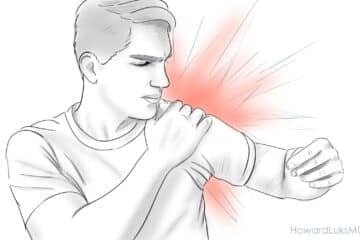
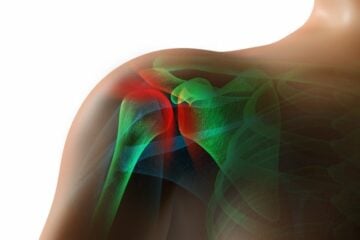
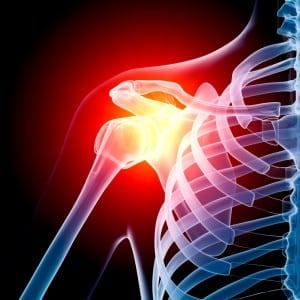
The most common cause of shoulder pain is overuse tendonitis, or strain of the rotator cuff. Other common causes of shoulder pain include degenerative tendinosis, frozen shoulder, dislocation or instability, rotator cuff tears, arthritis, and biceps tendonitis. If your pain lasts more than a few days, or if it worsens, talk to your doctor.
What is rotator cuff tendinosis?
In this photo, the white structure on the right is the top of the humerus. The frayed tissue just to the left is the rotator cuff. This patient was suffering from rotator cuff tendinosis and a partial-thickness cuff tear. Tendinosis represents a structural change to the tendon at a microscopic level, resulting in disorientation of the tendon structure and, ultimately, partial tearing as the weakened tendon tears. This is not the result of a single traumatic event. It is brought on by age and activity. Many patients with rotator cuff tendinosis and partial tears do not require surgery and will respond very well to a coordinated physical therapy program to strengthen the remaining cuff tissue. Ice and anti-inflammatories will work well, too. This is most likely the most common cause of shoulder pain in patients between 30 and 60 years old.
Can tendinosis or partial tears progress to full tears of the rotator cuff?
Great question, and unfortunately for nearly 50 percent of patients, the answer is yes. Within 5 years you have a 50 percent chance of the tear progressing to a full thickness tear -- that is why followup is necessary. Repeat MRI or ultrasound should be used in certain situations to visually examine the cuff and be sure the tear has not progressed.
How do I know if I have a rotator cuff tear?
Patients with rotator cuff tears complain of weakness and the inability to place the arm in certain positions; they usually have very severe pain at night. Patients have difficulty with hair care, putting on a bra or belt, and weakness when trying to lift the arm away from the side. Sometimes these symptoms are brought on by severe inflammation due to tendinosis, so a thorough physical examination by a Sports Medicine trained specialist is usually necessary to determine whether a tear is present. Occasionally an MRI is necessary to confirm the presence of a tear.
Do all rotator cuff tears need surgery?
Usually not. Many tears in people over 50 are simply the result of aging. We call these attritional tears, where the tissue simply wears out from use. Just like the front of your knee on your favorite pair of jeans -- sometimes the rotator cuff tendon simply wears out. An acute, traumatic tear in a young patient is a very different situation; these tears will usually require surgery to repair the tear and restore function. This is a topic that needs to be discussed in person with an appropriately trained surgeon to determine whether your tear should be treated operatively or non-operatively. Large acute tears should not be watched too long without surgery. They can retract and result in significant atrophy, which can make a repair very difficult, if not impossible.
What is an arthroscopic rotator cuff repair?
The arthroscope is a fiber optic camera inserted into the shoulder through a small stab wound. This serves as our eyes within the joint. With the advent of a multitude of arthroscopic instruments, we can now repair your rotator cuff, labral tear, or ligament tear using this approach. This eliminates the need for an open incision or an open approach in the majority of cases.
The advantages are numerous. We can actually see the tear better with an arthroscopic approach. We can treat any other pathology present at the same time.
Most surgeons are learning how to perform these repairs, so be sure you find someone who has done quite a number of these. Please view the sports medicine videos to see how the various procedures are performed.
Are children prone to certain shoulder problems?
Absolutely! In an actively growing child involved in overhead sports (e.g. pitching, volleyball, and swimming), the shoulder is at particular risk for developing certain problems. The more typical problems associated with overhead sports in the child athlete are instability (where the shoulder joint ligaments are stretched out), and stress fractures (which occur through the growth plates at the top of the humerus), and overuse tendonitis (a very common problem, even in children).
Cortisone is a form of steroid. This type of steroid is a very strong anti-inflammatory -- which is why it is usually successful at alleviating the pain associated with tendonitis. Cortisone has certain risks associated with it and should be used with caution in many people. Talk to your doctor about whether a steroid injection is appropriate for your shoulder pain. Cortisone is not useful for treating mechanical sources of pain -- such as a labral tear or a SLAP lesion. If a repair of the rotator cuff is planned, an injection is not advisable because it may delay or prevent healing.What is cortisone and how do cortisone injections work?
What is a SLAP lesion or tear?
A SLAP lesion is a tear of the labrum or cartilage disc that encircles the "socket" of the shoulder. A tear can occur as a result of a single traumatic event. More commonly, though, a tear occurs as a result of chronic repetitive stress associated with an overhead sport such as pitching. A tear can lead to mechanical symptoms (popping, snapping) or it can lead to instability, where the shoulder is loose.
SLAP lesions are very much over-diagnosed and over-treated.
If you have pain at rest or at night, or pain with simple motions and stiffness, your pain is most likely NOT caused by a SLAP lesion. Many, many, many people have labral tears simply as a result of aging and use. These are painless in most cases, and usually do not require treatment.
In younger patients with instability and difficulty throwing, pitching, slamming a volleyball, or similar activity, a SLAP lesion may be responsible for your symptoms. If therapy and other non-operative treatments fail, then surgical repair should be considered.
Do all SLAP tears need to be fixed?
Definitely not. Many people will develop SLAP lesions from normal use of the shoulder throughout their lives. Many post-mortem studies show that the vast majority of people have labral tears at the time of their death.
So, who should consider having a SLAP lesion fixed? If the surgeon believes that the SLAP lesion is the source of pain during overhead sports, then consideration should be given to fixing the tear. In most cases, SLAP lesions do not cause pain at rest or night, so if you are experiencing this, it means something else is bothering your shoulder.
How are SLAP tears fixed?
SLAP tears are fixed arthroscopically. The torn labrum is sewn back to the socket or glenoid with a number of sutures.
I would caution you not to have absorbable tacks used to fix your SLAP lesion.
You will need to rest your arm in a sling for a few weeks to allow the tear to heal.
If the tear heals satisfactorily, you should be able to return to your overhead sport within 4-6 months.
My shoulder snaps and pops and I hear clicking ... why?
There are many reasons your shoulder might snap or pop. In most situations this is not abnormal. Many shoulders snap, pop, and click -- and have no abnormality. Occasionally an unstable (loose) shoulder will snap or pop. On occasion a shoulder with a labral tear, SLAP lesion, or rotator cuff tear will pop or snap as well. But most of the time, snapping, popping, and clicking are not unusual and the sounds mean nothing.