• Skip to primary navigation
  • Skip to main content
  • Skip to primary sidebar
Howard J. Luks, MD

Howard J. Luks, MD

Orthopedic Surgeon Sports Medicine Specialist

  • Topics
    • Joint Pain
    • Longevity
    • Metabolic Health
    • Sports Medicine
    • Training
    • Top Articles
      • Zone 2 Training
      • Shoulder Pain Lifting Arm
      • Knee Injury Serious?
      • Medial Meniscus Tears
      • Front Of Knee Pain
      • Shoulder Snaps & Pops
    • All Articles
  • Newsletter
  • Podcast
  • Book
  • About
  • Consultation

Meniscus Injuries —How do they tear so easily?

Certainly one of the more common causes of knee pain I see in my office is because of a torn meniscus (sometime you search miniscus). Meniscus tears come in all shapes and sizes, and can be related to significant trauma, or virtually no trauma at all.

  • How do they tear?
  • Why do they tear?

Sometimes trauma or meniscus injuries are necessary — and sometimes our parts simply wear out.

 Meniscus injuries : many do not recall the event

Of the 100 or so patients I see each week, many are complaining of knee pain.  Some these patients have suffered  meniscus injuries,  some have not.  Many of the patients presenting with knee pain will prove to have a meniscus tear. How do meniscus injuries occur?

Some of the patients I see are young and have healthy meniscus tissue that tore as a result of trauma (sports or otherwise).  But the vast majority of patients I see with a meniscus tear are over 35-40.  While traumatic meniscus injuries and tears can occur in this age group as well, it is a far less common cause of tears in this age group and beyond.   By far, the most common type of meniscal tears I see in my office are atraumatic or attritional in nature.  Therefore, many can not recall any of their meniscus injuries … or there was no injury (per se) at all.
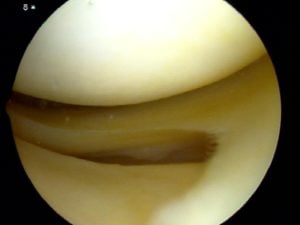
Normal Meniscus - Howard Luks - Westchester County, NY
Normal appearance of a meniscus

Meniscus Injuries: Can a tear occur without one?

It’s so frustrating for many! Why do these little cartilage disks tear so easily once we reach our fourth or fifth decades and beyond?
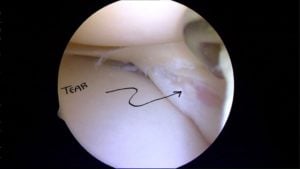
Meniscus Injury
Torn meniscus

As mentioned previously our miniscus tissue is non-regenerative.  This bears repeating over and over :-).  Sometimes our tissues simply wear out.  When I say that a tissue has poor regenerative potential, I mean it has a very poor ability to heal itself.   It’s similar to our brain or our heart tissues.  If we have a heart attack or a stroke, we do not regenerate those areas of our heart or our brain.  It simply scars in.  Yet if we cut our skin, our skin heals.  As opposed to our skin,  a tissue with enormous regenerative potential , our medial meniscus and our lateral meniscus do not possess the same regenerative or healing potential.  Many of our tissues in our body are injured by “repetitive micro-trauma”.  Our menisci have very few mechanisms for repairing itself.  Therefore, every step that you’ve taken, every twist that you’ve done, every time you’ve knelt down or squatted down, you’ve put a force across that meniscus and eventually it wears out and tears (this is why most tears are called degenerative tears). Sometimes meniscus injuries occurs by just turning and reaching for something in your refrigerator.  A lot of times people will note that they knelt down to pick up something, and when they went to stand up they felt something rip inside their knee and noted the onset of knee pain.

Thus, when told ” I don’t recall any  meniscus injuries” —  My usual reply is that the meniscus tissue probably wore out over time.
Primary Sidebar

Dr. Howard J. Luks

Howard J. Luks, MD is a leading orthopedic surgeon & sports medicine specialist. An expert in shoulder, knee, and other sports injuries, and author of Longevity... Simplified.

About · Contact · Private Consultation

Remote Guidance Sessions
  • Facebook
  • X
  • Instagram
  • LinkedIn
  • YouTube

Top Articles

The importance of VO2 Max

VO2 Max. It’s not just about your mitochondria

Walking is exercise

Walking IS Exercise: Why All Movement Matters

Zone 2 heart rate training

Zone 2 Heart Rate Training For Longevity and Performance

Do I have a serious knee injury

Is My Knee Injury Serious? 5 Signs to Look For.

Newsletter

Join the thousands of followers who rely on Dr. Howard J. Luks, a board-certified orthopedic surgeon specializing in Sports Medicine, with tools, tactics, and techniques for simplifying longevity.

Join 10K Subscribers
Subscribe Today

Read the Book

An easy-to-read guide that tosses out the myths and clears up the truth behind living longer. As you read this book, you will:

  • Understand the science behind the recommendations for living a longer and healthier life.
  • Understand that all our bodies’ systems are interconnected and rely on one another.
  • Connect the dots to poor metabolic health and take steps to reverse this path.
  • Recognize that fear doesn't need to be your reality.
  • Recognizing that most people view “exercise” as unpleasant work.
  • Stop going down “rabbit holes” of false information.
  • Realize you don't have to change as much as you think.
Find Out More
Read Reviews
Longevity... Simplified: Living A Longer, Healthier Life Shouldn’t Be Complicated

Available at:

Bookshop
Amazon
Barnes & Noble

Trending Now

  1. Zone 2 heart rate training
    Featured
    Zone 2 Heart Rate Training For Longevity and Performance
  2. Batters shoulder posterior labral tear
    Labral Tears
    Batter's Shoulder : Posterior Labral Tears
  3. LEg exercises improve longevity
    Longevity
    Runners require strength too: What to do and when to do it
  4. Seasoned Doctors Want to Leave Medicine.
    Sports Medicine
    Seasoned Doctors Want to Leave Medicine.

Howard J. Luks, MD

Orthopedic Surgery & Sports Medicine

128 Ashford Avenue
Dobbs Ferry, NY 10522

(914)-559-1900
[email protected]
Book Private Consultation

Topics

  • Joint Pain
  • Longevity
  • Metabolic Health
  • Sports Medicine
  • Running
  • Training

Browse All Articles

Joint Pain

  • Ankle
  • Elbow
  • Hip
  • Knee
  • Osteoarthritis
  • Shoulder

More Orthopedic Education

  • Topics
  • Newsletter
  • Podcast
  • Book
  • About
  • Consultation

© 2025 · Howard J Luks, MD · Disclaimer & Terms · Privacy Policy
The information on this site is not intended or implied to be medical advice, diagnosis, or treatment.
This site should be used for informational purposes only.