

Tim appeared no different than your average middle aged man. He was complaining of knee pain. His knee hurt when he woke up and it would be stiff if he sat still for a while and then tried to get up. He didn’t ask much from his knees … he gave up the activities he loved years ago.
Like many, Tim became “busy”. Too “busy” to exercise, too busy to walk at lunchtime, too many meetings, too little time for himself. He wasn’t particularly overweight by todays standards, but he could lose 20 pounds. He noted that his primary care doctor had just started him on medications for pre-diabetes, and hypertension. He wasn’t sleeping well… something he blamed on “stress”. Tim wanted to know what pill he could take to lessen his knee pain.
The physical exam was rather uneventful. His knee was a little swollen and his X-rays showed the very earliest signs of arthritis.
Our initial discussion about the potential treatments available to alleviate his discomfort didn’t go so well. Like the lunches he grabbed from a truck outside of work, Tim wanted the quick hit, quick fix so he could move on with his “busy” life.
But we had the talk …
If you don’t make time to be well … you had better plan the time to be a lot sicker.
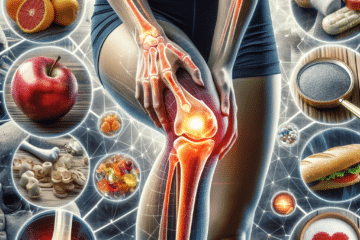
Tim ate a typical western diet — processed foods, little fiber, lots of meat. Tim didn’t exercise, had gained 20 pounds over the last few years and was heading down a very predictable path towards a life of pain, further weight gain, heart disease, kidney disease, neuropathy and misery.
“Do you understand how this is all related?” I asked.
No
Well… the contents of the Au Bon Pain bag you are clutching has more sugar in it then you should eat in a month.
Sugar is the enemy. And “Big Food” hides sugar everywhere.
- Sugar raises your insulin levels, which converts the sugar to fat — weight gain.
- Eating processed food that have no fiber causes your blood sugars to spike high.
- The insulin spike actually makes you hungry –> further weight gain.
- No exercise –> poor glucose and insulin control
- sugar spikes, high fat narrows arteries –> heart disease risk factor
- no exercise –> no cardiac reserve
- Poor insulin control due to sugar spikes and fluctuations –> diabetes
- Diabetes leads to a whole slew of conditions you WANT to avoid.
- Glucose spikes, low fiber diets leads to gut leakiness –>metabolic syndrome
- Metabolic syndrome leads to an increase in total body inflammation.
- That inflammation … aside from everything else it causes, will make your knees hurt more (full circle)
- and the cycle repeats.
Many at this point want to run out of the room. A few perk up and want to learn more. They haven’t heard it all pieced together like this before — especially from an Orthopedic Surgeon.
How could all these things be related?
They are… They are connected in more ways then you can imagine. The scientific community doesn’t even understand everything about how they are connected. To add to the confusion, it turns out that your diet also affects your microbiome — the collection of bacteria in your gut. 99% of the DNA in your body is not yours. Those bugs in your gut make chemicals, hormones and by-products that you absorb. Those byproducts have been shown to cause heart disease, obesity, arthritis, depression, and on and on.
A high fiber diet, low sugar diet can change your microbiome quite rapidly.
Tim was actually interested … we laid out a plan.
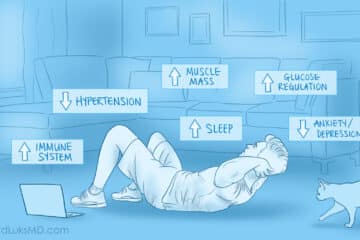
Nearly 6 months to the day, Tim returned to our office out of the blue. He lost 15 pounds, his knees no longer ached, he walked around at work every 15 minutes. He had walking meetings if it is possible. He ate a high fiber diet, and very few processed foods. He is off of his medications for hypertension and pre-diabetes…. and he just wanted to come in the to the office to say thank you.
We have enough knowledge in medicine today that we can start to truly help our patients change their lifestyle and prevent years of suffering … physical, financial, and emotional.
Sadly, in the rapid, mechanistic, box checking chaos we refer to as a typical physicians office visit that isn’t possible.
I sacrifice a lot to be able to offer people the time they need to understand far more than they thought they were going to hear when they came to the office.
With the current reimbursement models in place, and with Big Pharma and Big Food sitting atop those who throw an endless stream of bureaucratic nonsense our way on a daily basis … the needless suffering is going to continue.







Christian
Thanks again Dr Luks!
I shall wait to consult a specialist next month, since I am on the other side of the world and as much as I’d love to seek your professional advice in person, it’s just not practical.
Christian
Christian
Thanks for your feedback Dr Luks, much appreciated!
So are you highly recommending I consider surgery for my left knee?
I’m guessing my results aren’t reflecting a tear that can heal on its own over time?
I am not highly recommending it… I can’t offer treatment advice — only for patients I see in my office.
Christian
Hi Dr Luks,
Firstly, I’d just like to say I think what you’re doing online here is enormous. I agree with some of the comments, that more and more doctors should be taking your approach to medicine and health.
Secondly, I was wondering if I could seek your opinion on a “Complex Meniscus Tear” that I have recently been diagnosed with. My side of the World, the soonest I can see a specialist is a month away, and to be quite honest, anxiety is getting the better of me. That and my apprehension toward surgery.
A bit of back story, about 2 weeks back I engaged in a 30 minute run/jog and the very next day I felt pain in my left knee. Thinking nothing of it other than my muscles getting used to running again (as it has been about 1 month since I stopped running), the next day I went for another run, pushing through the pain. The day after this, my left knee began to hurt more and I couldn’t seem to walk unless I kept my leg straight and the pain was more pronounced when I climb stairs. I’m in my early 30’s.
After a consult, my local GP sent me to get an X-Ray and MRI.
The X-Ray confirmed no bone fracture or fluids present.
The MRI is the one my GP couldn’t give me any definite information on, other than it is a Complex Meniscus Tear and referring me to a specialist.
The MRI Findings:
– ACL, PCL, MCL and lateral collateral structures are normal in appearance.
– There is a complex tear within the body of medial meniscus, this consists of a 9mm oblique tear extending to the inferior articular surface at the peripheral third of meniscal substance, with superimposed vertical radial tear in the mid body, involving the inner 50% fibres and separated by 3mm. Moderate adjacent reactive marrow oedema and synovitis is present. No displaced meniscal flap.
– Lateral meniscus normal in size and configuration. Tibiofemoral articular surfaces are preserved.
– Patellofemoral articular surfaces are preserved apart from early grade 1/2 chondrosis within the medial patellar facet.
Extensor mechanism unremarkable. Moderate effusion with mild synovitis. No intraarticular body. Popliteal fossa unremarkable.
Not sure what it all means, but the word “Complex” doesn’t have a good ring to it.
Any insight into the results would be greatly appreciated.
Thanking you in advanced,
Christian
That report is your knee telling you you need to rest a bit — the bone marrow edema is present because the bone is reacting to the fact that you have a vertical/radial tear. That changes the way that force crosses the knee and it concentrates the force more locally. That causes bone marrow edema and eventually it can lead to a stress fracture.
Many of these tears at your age are repairable. Repairing vertical/radial tears has been studied over the past few years and it has good results … despite the fact that we never thought these “white zone” tears would heal.
Good Luck ! Find someone who repairs (sutures) tears together often. Most docs just like to trim out the torn part.
Frank Fearn.
Thank you Dr luks for being a great humanitarian. To give your time and expertise so unselfishly to those of us who are in shock with a torn maniscus.The realisation that with this injury we are getting older and with your brilliant advice,
especially your treating the (whole body)
article.I have gotten great conciliation and clearer understanding all your posts and comments. Thanks again!..Frank…..Dublin, Ireland.
:-) Very kind Frank :-)
Shannon Estavillo
Thank you, Dr. Luks……. I’ll schedule an appointment …… Most importantly thank you for your well written informing posts, you are a true asset to this aging athlete…
Shannon
I am an active 50 yr. old female. Recently diagnosed with tiny R knee meniscus tear, no pain able to cross fit train with no problems…… My L knee for years could become mildly uncomfortable but nothing worth mentioning….. My coaches and I are conservative with my workouts……. Last week while doing air squats my L knee started to hurt…. Now, I cannot lock out my knee, I’ve fallen because it just gives out….. For the most part any bending or manipulation of the knee causes discomfort if not pain……. My question assuming it’s torn, can I do more damage if I continue working out?
giving way is one of those issues that alarm us… because it means you can hurt yourself. It usually means that you have a torn flap or loose piece of meniscus.
Jeffery
Dr. Luks,
Thank you for you quick response to my inquiry.
Jeff
Jeffery
Hello Dr. Luks. My name is Jeff, a 54 year old, fit male living in Ohio. Very active in my business and other physical activities. last Thursday 12-17, I had my right knee scoped to repair a medial meniscus tear
( removed 40% – no repair ). What is troubling me is that, when I awoke from surgery my Surgeon informed me that there was only a ” nub ” left of the ACL with a small bone fragment dangling from that. He cleaned that out while there ( did not repair it ) .I was very shocked and disappointed that is was torn. Back Story: The original examination in his office did not include any hands on testing for ligament tears. He only did what I later researched to be The McMurray Test after I explained symptoms of occasional locking while sitting on the floor ( Indian Style) and certain time instability, like slippage in the joint. He did an MRI in his office that showed ACL intact and the meniscus tear.
So after all that rambling I would like to ask if there is anything else that could have been done to diagnosis ACL tear ? Is this normal procedure ? Thank You very much !
HI Jeff …
A comprensive exam will usually pick up an ACL tear. We use the MRI primarily to confirm suspicions. Except in very swollen and painful knees where a patient will not allow us to examine them.
Charlie Guidarelli
Good article . But I do wish I heard it from my Primary MD.. Thank You Dr Luks.
vini
Its useful article Dr….wanna more in future
medixpress
This is really useful and informative blog
Tina
Great article. I wish more doctors would treat their patients as a whole.