

Running does not cause arthritis. This is actually not a new finding. Researchers have known for years that running will not cause arthritis. Runners, in general, have a much lower chance of developing osteoarthritis than their non-running counterparts.
Runners entering their mid-life are understandably concerned that their running habits might be putting them at risk. Their friends chastise them for running and for putting their knees at risk. Thankfully, most runners can stash those fears and tell their friends that they’re simply wrong. Running will not cause arthritis…and now research is starting to reveal that running might actually protect the knee from developing arthritis.
In order to understand this better, we need to learn to think from both a biological perspective as well as a mechanical perspective.

The causes of osteoarthritis are complex
Form a mechanical perspective it would seem intuitively obvious that pounding your legs into the pavement by running day after day and year after year would wear our parts out faster. As an Orthopedic surgeon for nearly 2 decades, I can’t begin to count or tell you about all the times that something with seemingly sound intuitive reasoning was found to be inaccurate or false. The body has an incredible way of doing that. It is not only a mechanical wonder… it is a biological wonder with hundreds of thousands of proteins, chemicals, ions and hormones working throughout the body and governing the thousands of processes that keep us in homeostasis. Those compounds and proteins act upon our complex mechanical systems … and their actions can be profound. Therefore theories such as running causes arthritis are far too mechanistic.
Many of the studies performed on runners actually show that running can be protective with respect to the health of the cartilage. In another post on this site, we discussed why exercise actually makes an arthritic knee joint feel better. The basis of that lies in the fact that osteoarthritis development is a biological issue and not a pounding or wear and tear issue.
The role of articular cartilage
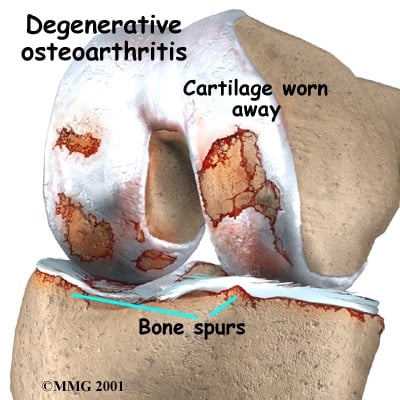
Our knees joints are protected by articular cartilage. Cartilage is a firm, hardy, exceedingly smooth surface. It has a very slow metabolism, and very little if any regenerative potential. Our cartilage is fed not by blood vessels, but by nutrients found in the fluid within our joints. When you walk you force that joint fluid under pressure into the cartilage surface.
Cartilage is composed of cells and a matrix. The matrix is produced by the cartilage cells. Pour chia seeds into a cup and fill the cup with water. The next morning you have a gel with the chia seeds suspended in it. Think of the seeds as the cartilage cells and the gel holding the seeds in suspension as the matrix. The health and quality of the cartilage matrix determine the overall health of the cartilage.
The matrix needs to be stiff and resilient. Collagen and substances known as proteoglycans are what make the matrix strong. As we age, or after an injury, the amount of type of collagen produced will affect the health of the matrix. As the strength of the matrix diminishes, the cartilage becomes frail and thinner. Loss of this matrix and cartilage cells is the hallmark of osteoarthritis.
In normal joint fluid, there are many hormones and chemical compounds. These chemicals, proteins, and hormones help regulate the health of the cartilage and the other structures within our knee joints.
A recent report showed that running a half marathon triggered the upregulation of genes in your DNA that code for the production of components of the cartilage matrix that make the matrix stronger and healthier. The researchers also found that Vitamin B6 appears to improve that response. This was a benchtop in-vitro study so that does not mean that you should start taking Vitamin B6.
We are what we eat
Our metabolism and how well our body regulates glucose, and cholesterol will affect our risk of developing osteoarthritis. Metabolic dysregulation, hyperglycemia, high cholesterol and other issues related to our overall health are common causes or contributors to the development of osteoarthritis. We have discussed how metabolic dysregulation (high glucose, high cholesterol) affects our joints and how it affects our tendons in two separate posts.
By far, the most common cause of osteoarthritis is genetics. If you have a parent who developed osteoarthritis then you may be at a higher risk of osteoarthritis, regardless of whether or not you eat well, exercise or run. Until we understand these mechanisms better, we are not able to prevent arthritis from worsening in these cases.
Biology matters…
The multitude of chemicals, proteins, and hormones within our knees can change over time. They can change by the hour, week, month or year. If we take a small amount of fluid from a normal knee and run some tests on that fluid we will find different chemicals and different concentrations of chemicals then we would in a knee with osteoarthritis. There are some compounds in our knee that can tell us how rapidly your cartilage is deteriorating.
Osteoarthritis is by definition an inflammatory disorder. Inflammation is a very complex process. A substance known as cartilage oligomeric matrix protein or COMP is a protein found in higher concentrations in the knees of people with osteoarthritis. Thus it is thought to be a marker for osteoarthritis. The lower the concentration of COMP the less chance that your arthritis will progress. Other inflammatory compounds such as cytokines and interleukins are also found in different concentrations in joints which are healthy versus those which are degenerating or deteriorating.
In a recent study, a number of volunteers were tested. One set of volunteers ran for 30 min. One group sat for 30 minutes. Before and after their run a small amount of joint fluid was taken to be tested. The scientists found that COMP, the marker for joint degeneration decreased immediately after a run… and increased after a period of sitting. Not only that, they found that COMP was higher in the blood of the runners. Therefore it appears that the act of running functioned to mechanically push the COMP out of the knee and into the bloodstream where it could not harm your knees.
This is a fascinating area of study and great news for runners in their mid-life who are concerned that their running might ruin their knees. It is safe to say that the current research suggests that:
- Running does not cause arthritis and …
- Running appears to prevent arthritic changes by decreasing the number of inflammatory chemicals found inside your knees after a run.
Stay tuned for more on this very interesting topic






Caio
Did you see this recent study: https://bmjopensem.bmj.com/content/5/1/e000586
pretty interisting. BTW, asymptomatic radiological findings.
RDM
I am 61 and have moderate OA Knee in my left knee. I have pain in my knee. Should I continue running.
Great question… A true runner will try to run through anything. I’m not saying that is a good idea. I’ve been a runner for a while, and treat many more everyday. Running after a diagnosis of arthritis can run the risk of making the arthritis worse… but that actually hasn’t been proven. If your knees bother than you should consider cross-training. If you understand the risks and are willing to take the chance then you can continue running. Arthritis, by definition will progress and worsen over time regardless of what you do.